RAG, Fine-Tuning, or Prompt Engineering: Choosing the Right Approach
Nir Shiloni
August 4, 2026
Table of contents
Picture a meeting room. Laptops open, screens flickering, everyone with that particular gleam in their eye. The first word in the air isn't "hello," it's "AI." And then comes the moment that always arrives: someone says, with total confidence, "We want ChatGPT. But ours. Now."
So I ask the question that stops the room every time: which data is the model going to learn from?
That question is where most GenAI projects quietly get decided, months before anyone books an architecture review. Because the three approaches on the table- prompt engineering, RAG, and fine-tuning- get discussed as if they were a maturity ladder, where you start at the bottom and graduate upward as you get serious.
They aren't. They're answers to three completely different questions, and picking by ambition rather than by constraint is the single most expensive mistake we see at CloudZone.
They Fix Three Different Problems
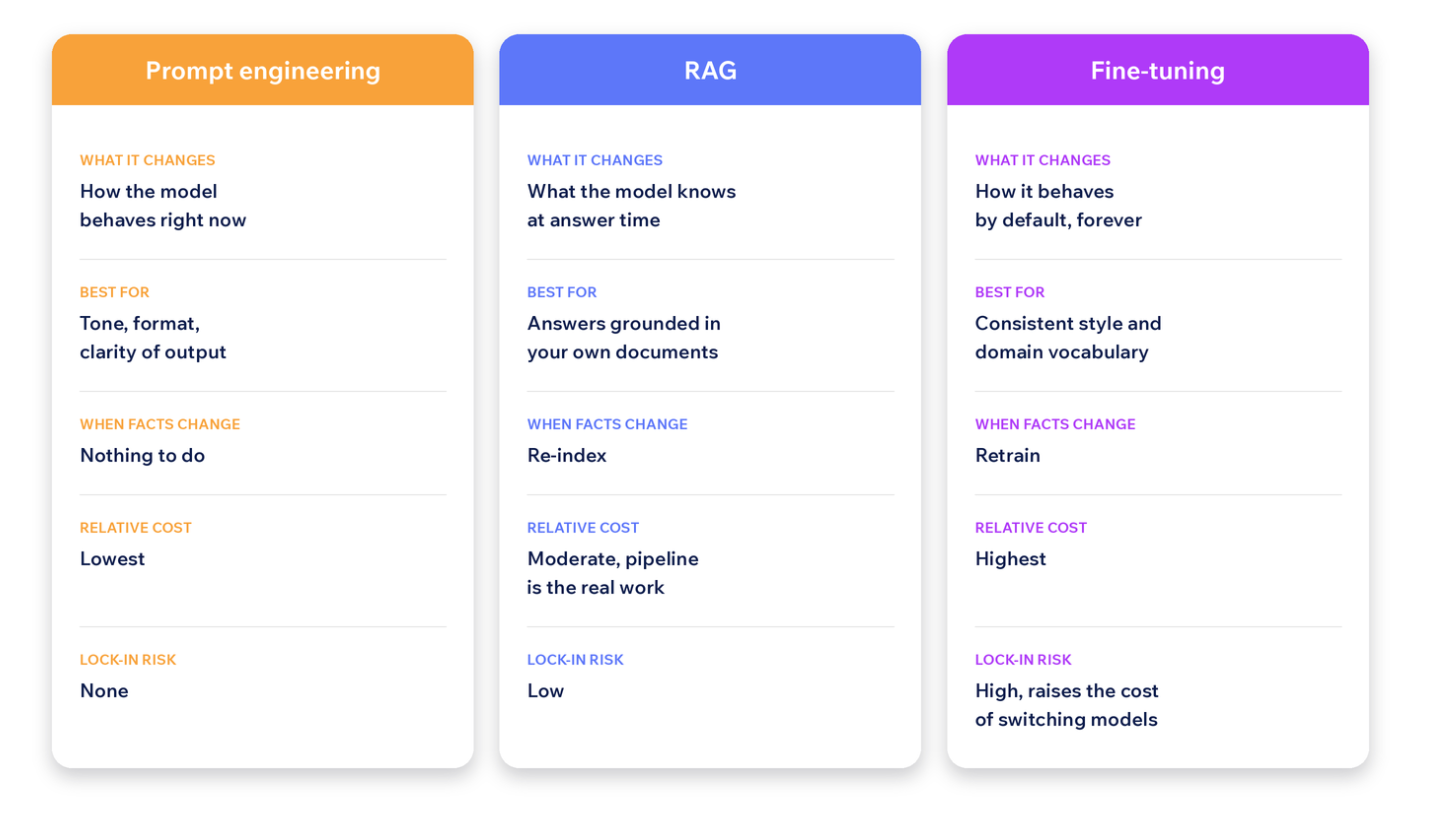
Prompt engineering changes how the model behaves with what it already knows. RAG changes what the model knows at the moment it answers. Fine-tuning permanently changes how the model behaves by default.
Say that out loud and a lot of arguments end. If your problem is "the answer is wrong because the model has never seen our contract templates," then no amount of prompt tuning will fix it. The information genuinely isn't there. If your problem is "the answer is correct but reads nothing like our support tone," retrieval won't fix it either, because the facts were never the issue.
Start with Prompts. Almost Everyone Skips This.
Prompt engineering is the cheapest, fastest lever available, and it's underrated because it feels too easy to be real engineering.
Be explicit. Don't ask for "a summary," specify what kind, for whom, in what tone, at what length. Precision in the instruction is precision in the answer. Give two or three examples of good output and quality jumps immediately; models learn from demonstration far faster than from description. Then A/B test your phrasings and keep a library of what works. Every team has its gems. Most never write them down.
RAG: When the Answer Must Come from Your Data
RAG is the right call when correctness depends on your documents. But here's the part that gets glossed over in demos: basic RAG rarely survives production.
The naive pipeline (embed, search, answer) breaks in predictable ways. Fixed-size chunking cuts mid-sentence and splits concepts. Pure vector search misses exact matches: IDs, acronyms, part numbers, internal names. Metadata sits unused, so irrelevant documents mix freely with relevant ones. Multi-hop questions simply fail. Worst of all, you get answers that sound smart and are wrong. With no feedback loop, the system never learns it.
Five patterns close that gap: semantic chunking, metadata filtering, hybrid retrieval, reranking, and query decomposition. If you only implement two, make them these:
Hybrid retrieval. Combine dense (embeddings) with lexical (BM25/RRF). Semantics catches meaning; lexical catches the product codes and acronyms semantics keeps missing. Together they give full coverage.
Query decomposition. Break a complex question into sub-questions: who, what, which documents, what date range. Retrieve precisely for each, then reassemble. Higher accuracy, fewer hallucinations, far more control.
Fine-Tuning: The Option Most Reach for and Least Need
Fine-tuning teaches behavior, not facts. It is genuinely good at format, tone, structure, domain vocabulary, and consistent classification.
What it doesn't do is make your knowledge current. Fine-tune on Q3 policies and Q4 arrives, and you're retraining rather than re-indexing. It also quietly deepens the pitfall we see hurt teams most: model lock-in. The market moves monthly. Betting on one model and staying there is how you end up paying more for less a year later, and a fine-tuned model raises the cost of ever moving.
Our rule of thumb: reach for fine-tuning only after prompt engineering and retrieval have both been done properly and a behavioral gap is still measurably costing you.
The Axis Nobody Puts on the Slide: Cost
On Amazon Bedrock, model choice alone can mean 10–500× cost differences. Moving from Nova to Claude Opus is roughly a 514× swing. That's not a rounding error. That's the budget.
So start small and cheap. Sometimes an SLM with a good prompt beats a frontier model with a lazy one, and it's faster too. Monitor token usage, cache repeated queries, batch where you can, and check Bedrock quotas per model per region before you plan for scale, not after production stalls.
The mechanics are straightforward. Time to first token grows with prompt size, throughput scales with output size, and bigger models trade slower answers for better ones.
The Order of the Questions
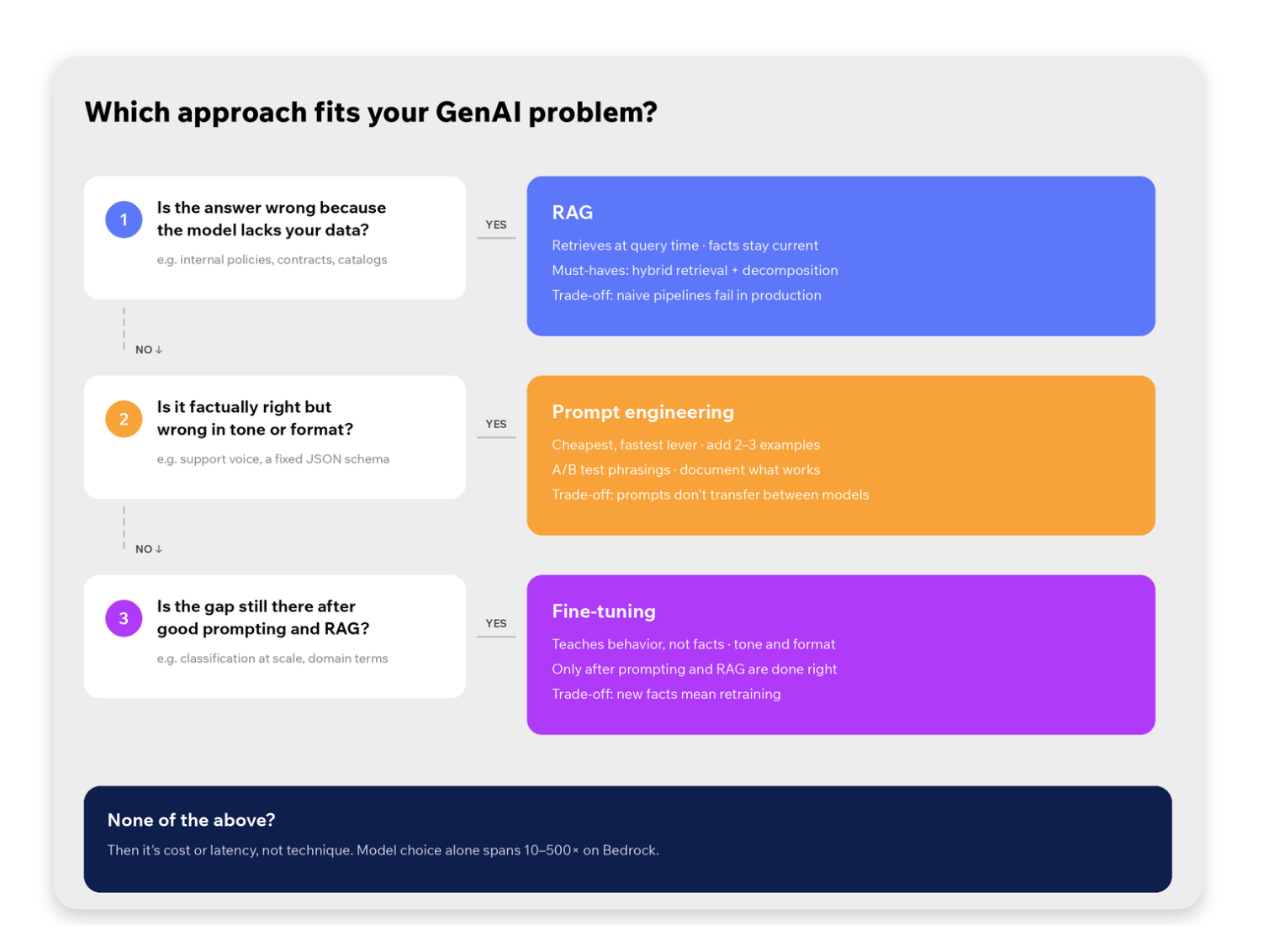
First: is the answer wrong because the model has never seen your data (internal policies, contracts, catalogs)? Then it's RAG, done properly, with hybrid retrieval and query decomposition.
Second: is it factually right but wrong in tone, format, or structure? Start with prompt engineering. It's the cheapest lever, and it resolves this more often than people expect.
Third: is the gap still there after good prompting and retrieval, and can you measure it? Only then does fine-tuning earn its place.
And if none of those fit, the problem is probably cost or latency rather than technique. That's a model and architecture decision, not a training one.
Most organizations answer yes to more than one, for different workloads, in the same quarter. That's a sign the decision was made correctly, several times over.
ScaleFlow came to us with a legacy knowledge base and poor retrieval accuracy. Semantic chunking, metadata filtering, and a real feedback loop brought a 40% reduction in ticket resolution time and 92% query accuracy. No fine-tuning involved.
Because the failure mode is rarely the model. It's the data, the retrieval, and the guardrails around it. Those are the unglamorous parts that make the impressive parts hold. Define success, measure it, refine relentlessly. Otherwise it's easy to fall in love with a beautiful illusion instead of a working system.
If you're weighing these three approaches against a real GenAI workload on AWS, that's exactly the kind of architecture decision CloudZone maps out with customers every week as an official AWS Anthropic Reseller for Claude on Amazon Bedrock. Book a GenAI architecture review.
FAQs
When should I use RAG instead of fine-tuning?
Use RAG when correctness depends on your own documents, or when that information changes. Fine-tuning teaches behavior, not facts, so new facts mean retraining, whereas RAG just means re-indexing.
Can I combine RAG, prompt engineering, and fine-tuning?
Yes, and mature systems usually do. They aren't mutually exclusive; they're separate levers. The mistake isn't combining them; it's reaching for the expensive one before the cheap ones have been done properly.
Is basic RAG enough for production?
Rarely. Naive pipelines fail on chunking, exact-match retrieval, and complex questions. Hybrid retrieval and query decomposition are the two patterns to treat as mandatory, not optional.
What is hybrid retrieval, and why does it matter so much?
It combines dense retrieval (embeddings, which capture meaning) with lexical retrieval such as BM25 or RRF (which captures exact terms). Semantic search alone misses IDs, acronyms, and product codes, precisely the terms enterprise users search for most.
How do I tell whether retrieval or the model is the problem?
Inspect the retrieved chunks before the model sees them. If the right passage never got retrieved, it's a retrieval problem and a bigger model won't help. If the passage was there and the answer was still wrong, then it's a prompting or model problem.
More from CloudZone
Danny Farber
September 1, 2026
Decision Architecture Framework (DAF): The Missing Layer Between AI and Enterprise Software
Software has always been built by encoding decisions into code. Artificial intelligence gives us the opportunity to separate decision-making from implementation for the first time.
AI
Or Dotan
August 11, 2026
24/7 Cloud Operations: The Four Levels Nobody Explains
Every managed cloud provider advertises 24/7 coverage. Almost none of them mean the same thing by it.
At one end, "24/7" means an alert fires at 3 AM, a system routes it to your inbox, and a human reads it when the business day starts.
MSP
Nir Shiloni
August 4, 2026
RAG, Fine-Tuning, or Prompt Engineering: Choosing the Right Approach
Picture a meeting room. Laptops open, screens flickering, everyone with that particular gleam in their eye. The first word in the air isn't "hello," it's "AI." And then comes the moment that always arrives: someone says, with total confidence, "We want ChatGPT. But ours. Now."










.png)