


How Context Optimization Makes AI Coding Agents More Efficient
AI coding agents need better context. Selecting, compressing, and retrieving the right information can reduce waste across the entire agent workflow.





AI coding agents need better context. Selecting, compressing, and retrieving the right information can reduce waste across the entire agent workflow.
Point an autonomous coding agent at a mid-sized enterprise repository and ask it to debug a failed container route. Before proposing a fix, it may inspect configuration files, search the repository, read database schemas, query documentation, and pull hundreds of lines of logs. If the first fix exposes a second failure, parts of that information may return to the model again, even when only a fraction still matters.
Context optimization is the process of selecting, structuring, and managing the information an AI agent receives so it can complete a task accurately with as little irrelevant material as possible.
For coding agents, that means managing files, tool output, instructions, and conversation history throughout the task. Done well, it can reduce token costs while preserving the detail needed for reliable execution.
In an agentic workflow, the context window behaves like working memory for a temporary software runtime. Code, instructions, tool schemas, retrieved documents, logs, and earlier observations compete for space and attention. Larger context windows give agents more capacity, but also more room to accumulate noise.
Context optimization is broader than context compression. Compression reduces the size of information already selected for the model; prompt compression applies that idea to prompt content. Retrieval determines which information enters the context, while memory management determines what persists, what expires, and what can be restored later. Context optimization brings these decisions together across the agent workflow.
The goal is to deliver enough information for the current step, preserve exact details where they matter, and keep additional information available when the agent needs it.
The intuitive assumption is that an agent performs better when it can see more. That is true only when the additional context is relevant, timely, and well-structured.
Research has repeatedly shown that long inputs create their own failure modes. The “lost in the middle” effect demonstrated that models can struggle to use relevant information buried inside a long prompt. More recent work on “context rot” found that model performance can degrade as input length grows, even before the advertised context limit is reached.
A 2025 EMNLP paper went further: across several reasoning, question-answering, and coding tasks, performance declined with longer inputs even when retrieval was perfect, and the relevant evidence was available.
For coding agents, this is not an edge case. Their normal operating environment produces context bloat:
This bloat has two costs. The visible cost is financial: more input and output tokens, more inference, and sometimes more tool calls. The less visible cost is cognitive: the model must distinguish signal from noise while preserving exact details such as types, error codes, security constraints, and API contracts.
That is why context optimization is broader than prompt compression. It is a lifecycle problem.
A mature context layer needs to make several decisions continuously:
Select: Which files, records, tools, and previous decisions are relevant to the current step?
Structure: Can raw data be converted into a representation that exposes relationships without carrying every byte?
Compress: Which repetition, boilerplate, or predictable language can be removed safely?
Cache: Which stable prompt prefixes can benefit from provider-side caching, and which previously processed artifacts can be reused locally?
Retrieve: If compressed detail becomes necessary later, can the agent restore the original on demand?
Forget: Which observations are stale, duplicated, or no longer consistent with the current plan?
Constrain output: Can the agent communicate and implement the solution without producing unnecessary explanation or code?
No single technique solves all seven. Recent open-source projects illustrate how optimization can happen at different points in the lifecycle.
Headroom, Caveman, and Ponytail are sometimes grouped together as token-saving tools, but they began at different points in the agent workflow. Their differences are more useful than their similarities because they reveal where bloat enters an agentic workflow.
Headroom sits between an agent and the model, targeting incoming context such as tool output, logs, files, retrieved documents, JSON, and conversation history. It can run as a local library, proxy, wrapper, or Model Context Protocol server.
Instead of applying the same truncation rule to every payload, Headroom routes different content through different strategies. Structured JSON can be compacted differently from source code; code can be reduced with awareness of its abstract syntax tree; prose can use a text compressor. Its Context Compress, Cache, and Retrieve mechanism keeps original content locally and gives the model a way to request the full version when a missing detail becomes necessary.
That reversibility matters. A log line that looks redundant to a generic summarizer may contain the one correlation ID needed to trace a failure. A private method body may be unnecessary while mapping a module, then become essential when the agent edits it. Compression is safer when it is a reversible navigation layer rather than permanent deletion.
Headroom also offers optional output controls in its proxy, including verbosity steering and effort routing for routine turns. These extend its scope beyond incoming context, although their impact needs to be measured separately from input compression.
As of this writing, the project reports reductions of roughly 20% for coding-agent workloads and 60–95% for highly structured JSON. Those are project-reported figures, not a universal guarantee. The achievable savings depend on the data: repetitive logs and schemas compress far better than dense code or already concise prose.
Caveman attacks a different source of waste: verbose model output. It instructs coding agents to use compressed prose, removing articles, filler, repetition, and ceremony while leaving code, commands, paths, and error strings intact.
Caveman’s original skill compresses output prose, while its newer proxy also compresses incoming tool output and other context. Shorter replies reduce generated tokens and also leave less conversational residue to carry into later turns. The concept is appealing because output tokens can be expensive and agent narration often becomes part of the next request.
But the distinction between chat and agentic work is important. Caveman advertises large reductions for prose-heavy output, while a July 2026 JetBrains evaluation of its original skill alone measured an 8.5% reduction in output tokens across real multi-step coding tasks, with no statistically detectable quality loss in that test. That result applies to the original skill, not the newer proxy. The smaller saving makes sense: code, diffs, tool calls, and exact technical strings dominate many coding sessions, while the skill shortens only the prose around them.
The lesson is bigger than one benchmark. Compression claims must be evaluated against complete task trajectories, not isolated responses. A technique that dramatically shortens prose may have only a modest effect when most tokens come from tools or code.
Ponytail works at yet another layer. It is not primarily a context compressor. It is an anti-overengineering skill that asks the agent to stop at the simplest adequate solution: reuse existing code, prefer a standard-library or native platform feature, use an installed dependency, and write new code only when the earlier options do not satisfy the task.
This targets code bloat rather than merely linguistic bloat. An agent asked for a date picker, for example, may add a dependency, wrapper component, styling, and edge-case machinery when a native browser control would meet the requirement. The unnecessary implementation consumes tokens while it is generated, creates more code for future agents to read, and expands the project’s long-term maintenance surface.
Ponytail’s published agentic benchmark reports 54% fewer lines of changed code and 22% fewer tokens than its baseline, while preserving the benchmark’s safety checks. Its own documentation is careful to say that minimizing tokens is not the objective: lower token use is a side effect of writing only what the task needs.
That makes Ponytail relevant to context optimization even though it does not squash input in the same way as Headroom. Today’s unnecessary code becomes tomorrow’s unnecessary context.
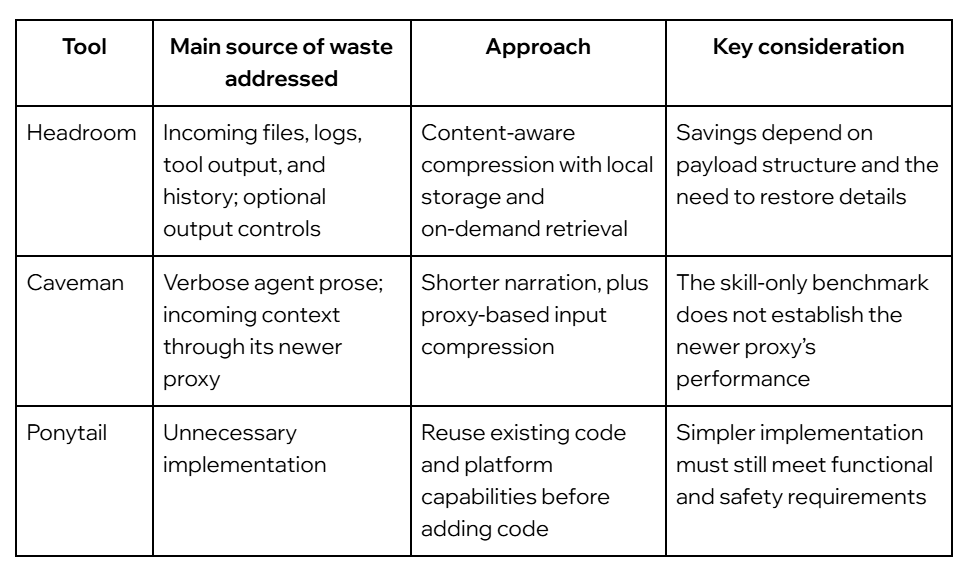
These tools address different sources of waste, with some overlap. Their published percentages come from different workloads and evaluation methods, so they should not be treated as a direct ranking or added together to predict combined savings.
These projects point to a broader architecture. Efficient agents will likely combine several layers rather than depend on a single compressor:
The operational goal is not the highest compression ratio. It is the highest useful information density: enough detail to solve the task, with as little irrelevant material as possible.
Token reduction is not free. Every optimization layer creates trade-offs that engineering teams need to measure.
Loss of critical detail: Semantic compression can remove a rare flag, boundary condition, or line of code that turns out to be decisive.
Retrieval loops: Aggressive compression may force the agent to repeatedly restore original content, eliminating the saving and adding latency.
Cache disruption: Rewriting a stable conversation prefix can reduce the benefit of provider-side prompt caching, even if the rewritten prompt is shorter.
Local overhead: Parsing source code, ranking results, running compression models, and maintaining memory stores consume CPU, memory, and time.
Evaluation mismatch: A benchmark built from repetitive JSON may say little about a real session dominated by source code, exact diffs, and tool calls.
Security and governance: A local-first design may reduce unnecessary data exposure, but teams still need controls for cache retention, secrets, access boundaries, and the information an agent is allowed to retrieve.
Teams should measure cost per successful task rather than tokens saved in isolation. A compressed run that is cheaper but requires retries or additional human work may erase the apparent saving. Evaluation needs to cover the complete task, including follow-up attempts and repairs.
Start with representative work from your own repositories, such as debugging a failed build, tracing an API error, or implementing a small feature. Define success before testing, using relevant tests and human review where needed. Compare baseline and optimized runs with the same model, task instructions, repository starting state, and execution budget. Repeat the comparison across multiple runs because agent behavior can vary.
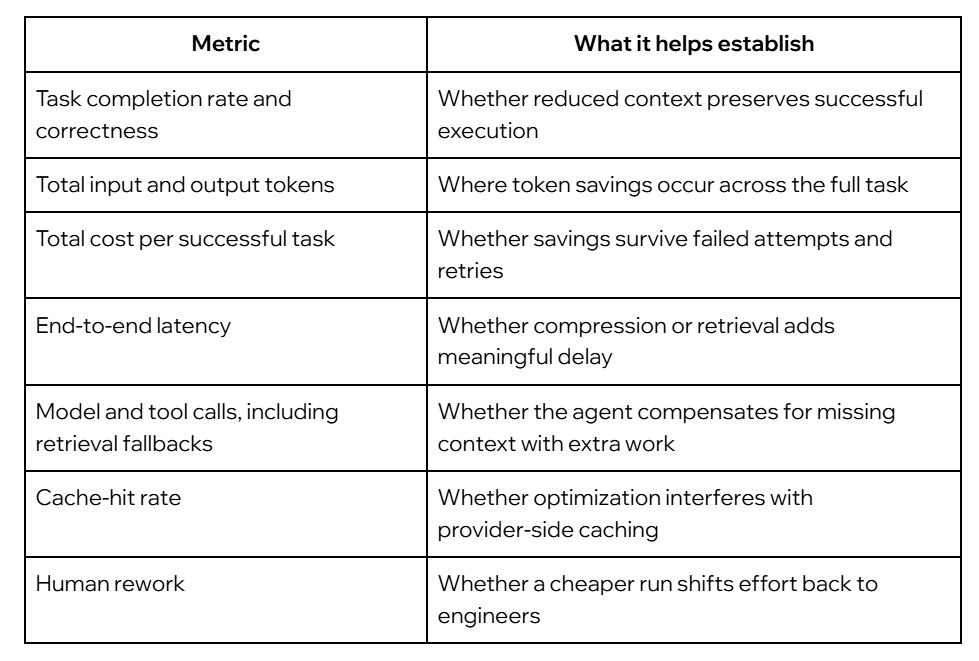
Test one optimization layer at a time before combining them. This makes it easier to identify whether the improvement comes from better retrieval, less repetitive input, shorter output, or simpler implementation.
Context Is Becoming an Engineering Resource
Software teams already manage compute, storage, networking, and observability as finite resources. Context now belongs on that list.
Headroom, Caveman, and Ponytail show how the cost problem extends across the entire agent loop. Headroom and Caveman address incoming context and agent output through different mechanisms, while Ponytail focuses on reducing unnecessary implementation. Each approach influences what the agent has to process now and what future sessions may have to read.
Efficient systems need to decide what the model should see, what can remain outside the window, what must be preserved exactly, and what can be restored on demand. The practical test is whether those decisions help the agent complete real work reliably at a lower total cost.
Context optimization is the process of selecting, structuring, compressing, and managing the information a coding agent uses throughout a task. It covers source files, tool output, instructions, and conversation history, with the goal of reducing irrelevant material while preserving what the agent needs to work accurately.
Context compression reduces the size of selected information. Context optimization also determines which information to include, how to organize it, what to retain or forget, and when to retrieve original details. Compression is one part of that broader process.
Compare baseline and optimized runs on representative tasks with predefined success criteria. Measure total cost per successful task alongside correctness, latency, token use, retrieval fallbacks, and human rework. Fewer tokens are useful only when the resulting workflow still delivers reliable outcomes.

AI coding agents need better context. Selecting, compressing, and retrieving the right information can reduce waste across the entire agent workflow.

Picture a meeting room. Laptops open, screens flickering, everyone with that particular gleam in their eye. The first word in the air isn't "hello," it's "AI." And then comes the moment that always arrives: someone says, with total confidence, "We want ChatGPT. But ours. Now."


.png)