



Designing AI Systems for Security and Operational Excellence
Consider a hypothetical regional financial institution deploying a conversational agent to analyze credit risk across its portfolios.





Consider a hypothetical regional financial institution deploying a conversational agent to analyze credit risk across its portfolios. The engineering team expects significant efficiency gains and faster insights. For the first few days, the system runs smoothly.
Then an analyst asks for a counterparty’s netting set exposure under stressed market conditions. The semantic cache returns a standard exposure report generated for a different context. Its similarity threshold has prioritized phrasing over financial context, delivering a materially wrong answer to the risk desk.
Meanwhile, monthly token expenditure exceeds projections by thousands of dollars because redundant regulatory context is loaded into every system prompt. A separate user exploits a prompt-injection vulnerability to extract sensitive backend data. When the compliance team requests an immutable audit trail linking the model’s exact payload to the agent’s autonomous decisions, the architects discover that the necessary telemetry does not exist.
This scenario illustrates a significant shift in modern software development. AI architecture places increasing responsibility on engineering teams across multiple disciplines. They must select the right models, tools, and platforms while keeping systems well governed and within budget.
Security and operational excellence must be embedded in the architecture from the outset. As AI becomes more heavily regulated and security threats grow more sophisticated, organizations face increasingly demanding standards. They must be able to audit, explain and act in real time to prevent the risks introduced by AI from outweighing its benefits.
During the rapid adoption of cloud infrastructure and modernization, hyperscaler frameworks acted like train tracks, keeping engineering teams on a predictable path. Learning cloud practices and finding the right partner gave teams a foundation for achieving operational excellence and efficiency through sound architecture.
Today, software architecture extends beyond cloud infrastructure, containers and data platforms. Engineering teams use models from frontier AI laboratories and integrate solutions from specialist AI providers. Hyperscalers are consequently becoming comprehensive AI factories that supply models, learn from vast datasets and offer specialist platforms across the development lifecycle, without necessarily developing their own cloud-native AI models and technologies.
This shift requires hyperscalers to remain relevant as governance and procurement platforms. They provide the foundation for data sovereignty, agentic guardrails, audit assurance and security management, while serving as trusted marketplaces for certified specialist platforms across the operating chain.
Engineering teams must expand their expertise in tokenization strategies, context-driven decision mapping, data refinement for semantic relevance, and multi-agent orchestration. Established managed services providers (MSPs), such as CloudZone, therefore have a pivotal role in helping customers navigate the hyperscaler transformation and maintain compliance with increasingly demanding standards.
CloudZone acts as a partner to core engineering teams, translating abstract operational requirements into concrete architectural guardrails that run automatically to support scalable development and operations. It also acts as a selective marketplace competency partner, certifying and recommending suitable solutions from specialist AI providers.
Engineering teams need a detailed understanding of how a large language model (LLM) performs in a specific use case, including its actual payload and data sovereignty footprint. Relying on application logs to investigate errors afterward and correct them quickly falls short of modern resilience standards.
Traceability of context and decisions must be integrated directly into the infrastructure. Traditional observability conventions for HTTP requests and database queries fall short when applied to generative AI. Billing depends on token volume rather than request count, while generation parameters affect the meaning and behavior of outputs.
The OpenTelemetry GenAI Semantic Conventions address this observability gap by standardizing the vocabulary for AI telemetry under a unified namespace. They support consistent tracing of observed steps in multi-stage AI workflows across model providers. Core span attributes capture the provider, the requested and responding models, and input and output token usage.
To protect sensitive data, actual prompt and response payloads are captured strictly on an opt-in basis through separate event logs. This design prevents personally identifiable information (PII) from entering standardized indexed attributes, giving engineering teams precise control over their data footprint. Granular instrumentation allows teams to mask sensitive information before it reaches the logging backend, fulfilling strict privacy obligations while the MSP maintains deep operational visibility.
As AI architectures move from single-prompt interfaces to autonomous agents, the security surface expands exponentially. Agents use dynamic tool discovery to connect with organizational databases, file systems, and external APIs. The Model Context Protocol (MCP) standardizes this interaction, enabling agents to authenticate against and invoke external data sources seamlessly.
Autonomous decision-making introduces vulnerabilities that traditional database security frameworks cannot address natively. An agent querying an MCP server requires strict role-based access control at the tool level to prevent privilege escalation. Fine-grained controls ensure that agents access only the capabilities appropriate to their responsibilities.
Every invocation must generate an immutable audit trail linking the human user’s identity to the agent’s actions. This gives compliance teams the evidence they need to demonstrate proper access governance during regulatory reviews.
Security by design requires a centralized control plane that inspects and manages traffic before it reaches the model. AI gateways provide this enforcement point for every model call, tool invocation, and agent-to-agent communication.
A high-performance gateway directly addresses critical LLM vulnerabilities, including prompt injection, data poisoning, and unauthorized data exfiltration. These platforms combine deterministic checks with adversarial classifiers to block malicious inputs, identify jailbreak attempts, and redact sensitive information in real time.
Once a gateway is live, an MSP with AI expertise can maintain virtually undetectable latency overhead, with complex requests often processed in milliseconds. This is essential to maintaining a fluid user experience in production.
The MSP also maintains operational stability through dynamic model routing, automated failover, and centralized token budgeting across tenants. Bringing inference traffic into a single governed layer allows customers to eliminate ungoverned shadow usage, regain full visibility into token economics, and ensure that sensitive data processing stays within predefined geographical sovereignty boundaries.
Operational excellence requires an understanding of architectural trade-offs, particularly in cost reduction. Semantic caching reduces token costs and latency by serving stored responses to similar user queries.
In risk-sensitive environments, however, semantic caching introduces serious vulnerabilities. In finance and healthcare, a small change in phrasing can carry substantial contextual weight. In the hypothetical market-risk scenario, a semantic similarity threshold of 0.87 might incorrectly match a generic query with one requesting a stressed scenario, producing a dangerous cache hit.
Engineering teams must assess these trade-offs carefully, choosing prompt caching for environments with strict regulatory requirements and reserving semantic caching for lower-risk or highly repetitive information retrieval. Continuous monitoring and adjustment remain essential once the system is in production.
As AI capabilities advance, security and reliability threats become more severe. Regulators and industry bodies are establishing strict standards that demand proactive compliance frameworks embedded in systems. Organizations must continuously capture structured evidence for rigorous conformity assessments and implement automated playbooks for alerting and immediate remediation.
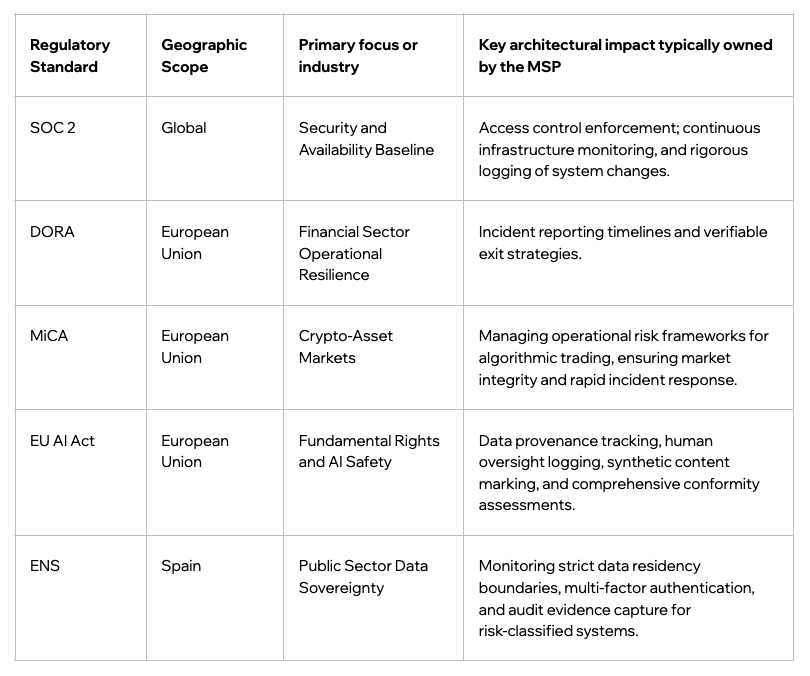
Evolving hyperscaler capabilities, complex token economics, and demanding regulatory frameworks place traditional software development methods under increasing strain. Engineering teams must balance rapid feature innovation with the operational burden of deploying secure, highly compliant, and cost-effective infrastructure.
Specialist MSPs bridge this operational gap. The infrastructure expertise of a provider such as CloudZone gives organizations a trusted partner uniquely capable of translating complex regulatory requirements into automated deployments. Engineering teams can rely on proven architectural blueprints that embed semantic logging, real-time gateway guardrails, and cryptographic audit trails into the delivery lifecycle, freeing them to focus on core business logic.
AI continually exposes businesses to new threats and legal liabilities, making reactive compliance inadequate for business operations. Engineering teams must build verifiable safety into their foundations from the first design decision and demonstrate to users, auditors and regulators that their systems operate securely under pressure.
Operational excellence requires infrastructure that anticipates audits, neutralizes security threats in real time, and maintains command of the AI context.
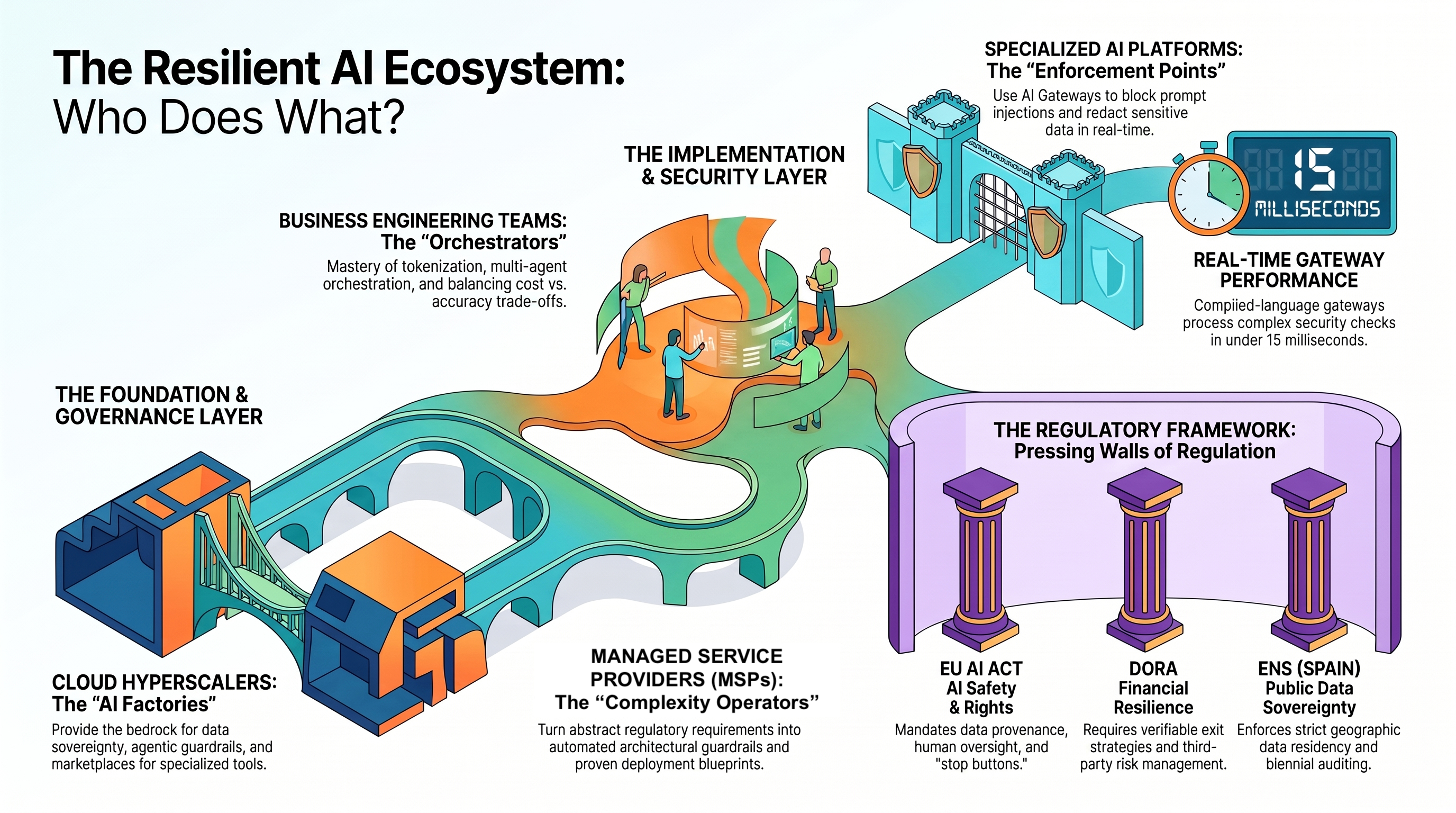
AI systems introduce interconnected responsibilities across security, governance, observability, and cost control. Embedding these considerations in the initial architecture helps engineering teams manage model behavior, agent access, token expenditure, and audit evidence throughout development and operation.
The article describes hyperscalers as increasingly important governance and procurement platforms within a broader AI ecosystem. Engineering teams combine their infrastructure with models from frontier AI laboratories and specialist tools, making platform selection and integration central architectural decisions.
Semantic caching serves stored responses to similar queries. In financial applications, similar wording can refer to materially different conditions, such as standard exposure and stressed exposure. A cache hit based on similarity can therefore return an answer that is inappropriate for the current risk context.
Agents can interact with organizational databases, file systems, and external APIs. Tool-level access controls restrict them to capabilities appropriate to their responsibilities, helping prevent privilege escalation. Audit trails connect agent activity to user identity and support access-governance reviews.

Consider a hypothetical regional financial institution deploying a conversational agent to analyze credit risk across its portfolios.