


How Context Optimization Makes AI Coding Agents More Efficient
AI coding agents need better context. Selecting, compressing, and retrieving the right information can reduce waste across the entire agent workflow.





Most conversations about MSP vs. in-house cloud operations begin with the wrong question.
Companies ask whether they should manage their cloud internally or hand it over to a managed service provider, as though one side needs to own the entire environment.
In practice, the strongest cloud operating models combine both.
Internal teams understand the company’s product, customers, roadmap, engineering constraints, and commercial priorities. An experienced MSP brings cloud strategy, platform expertise, continuous operational capacity, and lessons learned across many environments.
That wider perspective is difficult to build inside one company. An internal team may know its own environment deeply, while a partner working across hundreds of environments can identify recurring risks, cost patterns, architectural limitations, and operational gaps earlier.
The real objective is therefore to build a shared cloud responsibility model that defines what each side contributes, where the MSP should lead, and how decisions are made together.
The internal team should remain the source of truth for business goals, product priorities, customer commitments, engineering constraints, and acceptable risk.
An experienced cloud MSP should help translate those inputs into a cloud strategy, architecture roadmap, operational model, and prioritized improvement plan. It can also lead areas that require continuous coverage, specialist expertise, or capabilities that are difficult to build and maintain internally.
The company retains final decision authority. The MSP brings strategic cloud guidance, cross-environment experience, and the execution capacity required to turn business priorities into a stronger cloud environment.
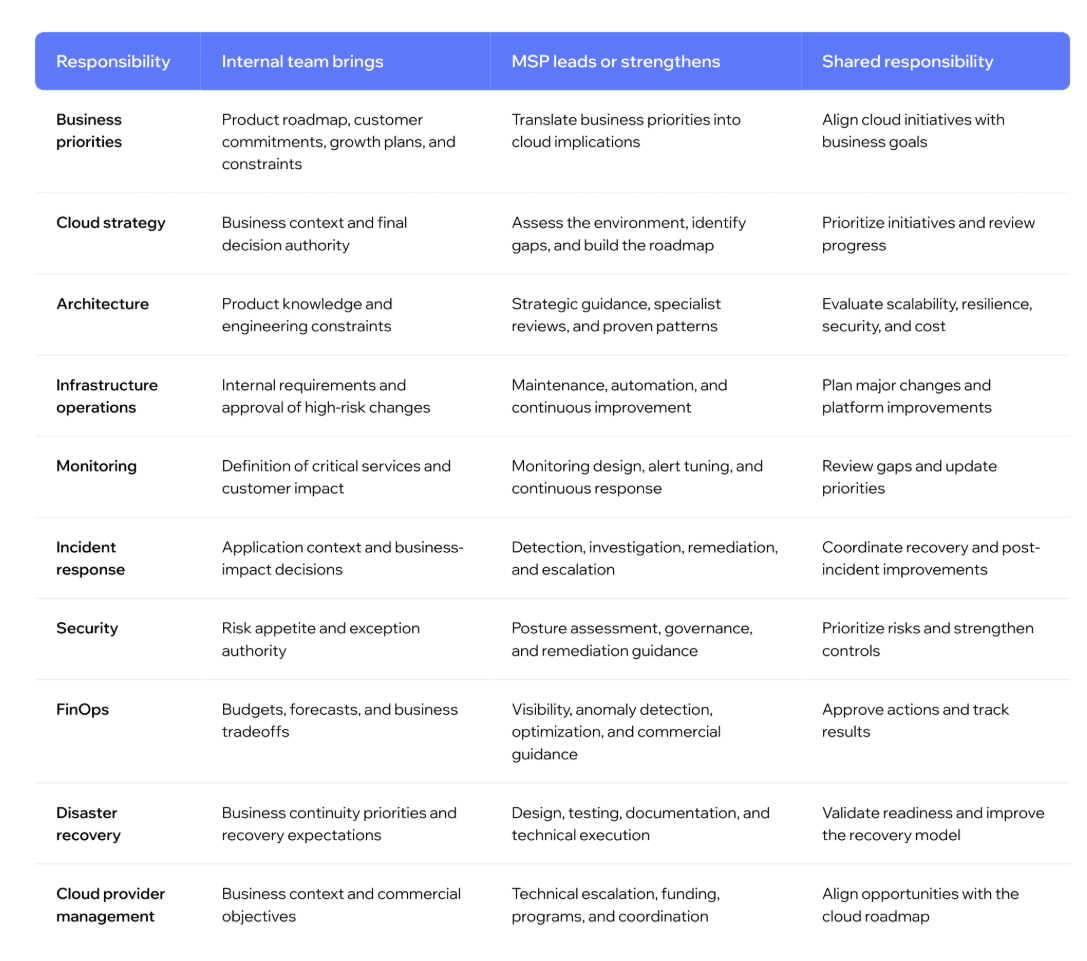
A shared cloud responsibility model defines how the internal team and the MSP work together across strategy, architecture, operations, security, cost, and incident response.
It separates three elements that are often treated as one:
Context comes from the business. The internal team knows what the cloud needs to support, which services matter most, and which tradeoffs are acceptable.
Cloud expertise and strategic guidance may come from the MSP. The partner assesses whether the current environment can support the company’s goals and recommends how it should evolve.
Execution can sit with either side depending on the capability, urgency, and level of specialist knowledge required.
Responsibility defines who performs the work. Accountability defines who approves the decision and owns the outcome. A strong operating model makes both explicit before an incident or major change exposes the gaps.
The internal team should bring the business and product context behind every cloud decision.
It knows which workloads are critical, what customers expect, where the business is heading, which engineering constraints matter, and how much operational, financial, or security risk the company is willing to accept.
Application-level knowledge should also remain close to the engineers building the product. Infrastructure data may show increased latency or database pressure, but internal engineers understand how application logic, recent releases, customer behavior, and third-party dependencies may be contributing.
The company should also retain final authority over major decisions involving customer impact, significant cost commitments, risk, and strategic priorities.
However, retaining decision authority does not mean the internal team should be expected to design the entire cloud strategy alone.
The customer provides the goals, constraints, and context. The MSP should challenge assumptions, identify options, recommend priorities, and translate the business direction into a stronger cloud model.
An MSP should lead where cloud specialization, continuity, and cross-environment experience create a clear advantage.
This begins with strategy. A mature MSP should assess the existing architecture and operating model, identify capability gaps, reveal risks and missed opportunities, and build a roadmap tied to the company’s goals.
Because it works across many environments, an MSP can often recognize patterns before they become obvious internally. It may identify that an architecture is approaching a scaling limit, that rising costs point to an inefficient design, or that too much operational knowledge depends on one engineer.
The MSP should then connect strategy to execution.
This can include 24/7 monitoring and incident response, infrastructure operations, security governance, disaster recovery, automation, FinOps, provider escalation, and specialist AWS or Google Cloud expertise.
Reliable 24/7 support, for example, requires more than forwarding alerts to an on-call engineer. It depends on qualified responders, clear severity definitions, documented remediation paths, effective handovers, and established escalation procedures.
FinOps also requires ongoing discipline. An MSP can provide cost allocation, forecasting, anomaly detection, commitment planning, architectural cost analysis, and commercial guidance. The internal team can then assess those recommendations against product priorities and expected growth.
The value of an MSP is not simply additional capacity. It is the combination of strategic guidance, pattern recognition, specialist depth, and consistent execution.
Some cloud responsibilities require both internal context and external expertise.
During an incident, the MSP can lead detection, triage, infrastructure investigation, cloud provider escalation, and approved remediation. The internal team contributes application knowledge and makes decisions involving customers, product behavior, and business tradeoffs.
Architecture reviews work similarly. The MSP brings tested patterns and an external view of scalability, resilience, security, and cost. The internal team ensures the recommendations fit the product roadmap and engineering model.
FinOps, security, disaster recovery, capacity planning, and change management also benefit from shared ownership. The MSP provides continuous guidance and execution, while internal leaders contribute business context and retain approval authority.
This model should be reviewed as the environment, organization, and business priorities change.
The first indication is not always a major outage. It is often a gradual accumulation of operational pressure.
Senior engineers may spend increasing amounts of time on alerts, maintenance, provider tickets, and cost analysis. Incidents may depend on one or two key people. Security improvements, disaster recovery testing, and automation may remain delayed because product work takes priority.
Cloud spend may grow without adequate visibility. The company may accumulate separate providers for support, security, FinOps, and consulting, leaving no one with a complete view of the environment.
Expansion across regions, services, or cloud platforms may also expose the limits of a model created for a smaller operation.
These are not signs that the internal team has failed. They indicate that the responsibilities and capabilities required by the environment have changed.
A shared cloud responsibility model should improve visibility and accountability, not weaken them.
The customer should retain access to its cloud accounts, data, tools, dashboards, and documentation. Permissions should match the agreed scope, and major changes should follow a clear approval process.
The model should define where the MSP can act independently, when internal approval is required, and who leads each type of incident.
Knowledge must also remain shared. Architecture decisions, runbooks, incident reviews, optimization plans, and change records should be accessible to the internal team.
A designated MSP team can add more value than a general support queue because it learns the environment, history, stakeholders, and business priorities. That continuity supports stronger strategic guidance and faster response.
The decision between an MSP and in-house cloud operations is not about deciding who should control the entire cloud.
Internal teams bring critical knowledge of the business, product, customers, and engineering organization. An experienced MSP brings broader cloud expertise, strategic perspective, operational capacity, and pattern recognition gained across many environments.
The strongest model combines both.
The company defines its goals, constraints, and priorities and retains final authority. The MSP helps determine what the cloud needs to become, which improvements matter most, and how to implement them.
It is a defined operating model that explains what the internal team owns, where the MSP leads, which responsibilities are shared, and who has decision authority. It covers areas such as strategy, architecture, operations, security, FinOps, and incident response.
Yes. An experienced MSP can assess the current environment, identify gaps, guide architectural and operational priorities, and build a roadmap connected to business goals. The internal team provides context and retains final authority.
Yes. The internal team brings product and engineering knowledge, while the MSP adds strategic guidance, specialist expertise, continuous coverage, FinOps, security, and operational capacity.
It should not. Control comes from clear decision authority, access, reporting, permissions, and documented responsibilities. A strong MSP relationship can improve both visibility and accountability.
Common signals include senior engineers spending too much time on operational work, incidents depending on a small number of people, limited out-of-hours coverage, poor cost visibility, and important infrastructure improvements being repeatedly delayed.
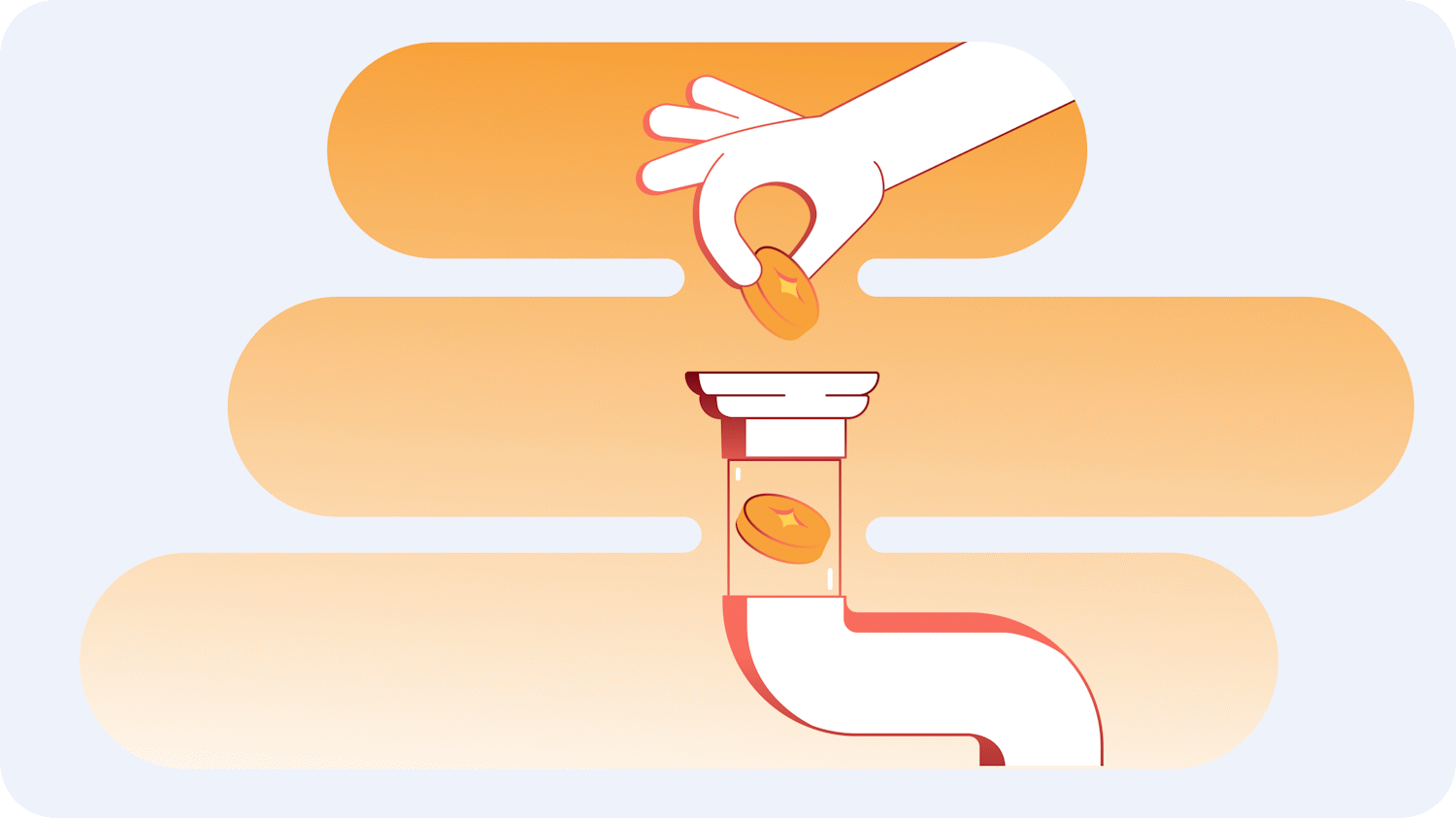

AI coding agents need better context. Selecting, compressing, and retrieving the right information can reduce waste across the entire agent workflow.
Picture a meeting room. Laptops open, screens flickering, everyone with that particular gleam in their eye. The first word in the air isn't "hello," it's "AI." And then comes the moment that always arrives: someone says, with total confidence, "We want ChatGPT. But ours. Now."

.png)