Decision Architecture Framework (DAF): The Missing Layer Between AI and Enterprise Software
Danny Farber
September 1, 2026
Table of contents
Software has always been built by encoding decisions into code. Artificial intelligence gives us the opportunity to separate decision-making from implementation for the first time.
Introduction: Why Enterprise AI Is Reaching an Architectural Limit
Imagine you're deploying a new version of a customer-facing service. Traffic briefly spikes, CPU utilization exceeds ninety percent, and an AI operations assistant automatically scales the production cluster. Ten minutes later, the deployment finishes and utilization returns to normal, but the organization discovers it has provisioned hundreds of unnecessary instances in one of the most expensive cloud regions in the world.
Nothing actually failed. The monitoring platform worked exactly as expected, the infrastructure APIs behaved correctly, the language model generated a reasonable recommendation, and the automation platform executed the requested action. Every component did its job, and the system still made the wrong decision.
This kind of failure is becoming common as organizations move AI from prototypes into production. The technology is improving fast, but our architectural assumptions haven't kept pace.
A few years ago, organizations were experimenting with conversational assistants that answered questions or generated content. Today, those same organizations are building systems expected to review contracts, approve financial transactions, optimize cloud infrastructure, diagnose production incidents, generate software, coordinate operational workflows, and increasingly participate in decisions that directly affect business outcomes.
The technical progress behind this shift has been real. Foundation models have improved dramatically, orchestration frameworks have simplified integration with external systems, and Model Context Protocol (MCP), tool calling, retrieval systems, and agent frameworks have made it straightforward to connect language models to business applications. From a purely technical standpoint, building an AI-powered system has never been easier. Building one that behaves predictably in production has never been harder.
That contradiction shows up across almost every industry. A cloud operations assistant scales production infrastructure because CPU utilization crossed a predefined threshold, without recognizing that engineering is already mid-deployment and temporarily driving that same consumption. A financial assistant approves an invoice because every required field is present and every validation passes, unaware that the supplier is currently under compliance review for an unrelated regulatory matter. A customer support assistant hands out technically accurate troubleshooting steps even though monitoring has already confirmed a regional outage affecting thousands of users.
Each of these systems looks intelligent. Each runs a capable language model, invokes enterprise APIs successfully, and executes exactly as designed. And each one still reaches the wrong conclusion.
None of these failures trace back to a weakness in the language model itself. The models reason correctly given the information they have. APIs respond as expected, workflows execute successfully, and observability platforms collect accurate telemetry. The failure sits somewhere between understanding the current situation and choosing the right action. In other words, the problem has shifted from execution to decision-making.
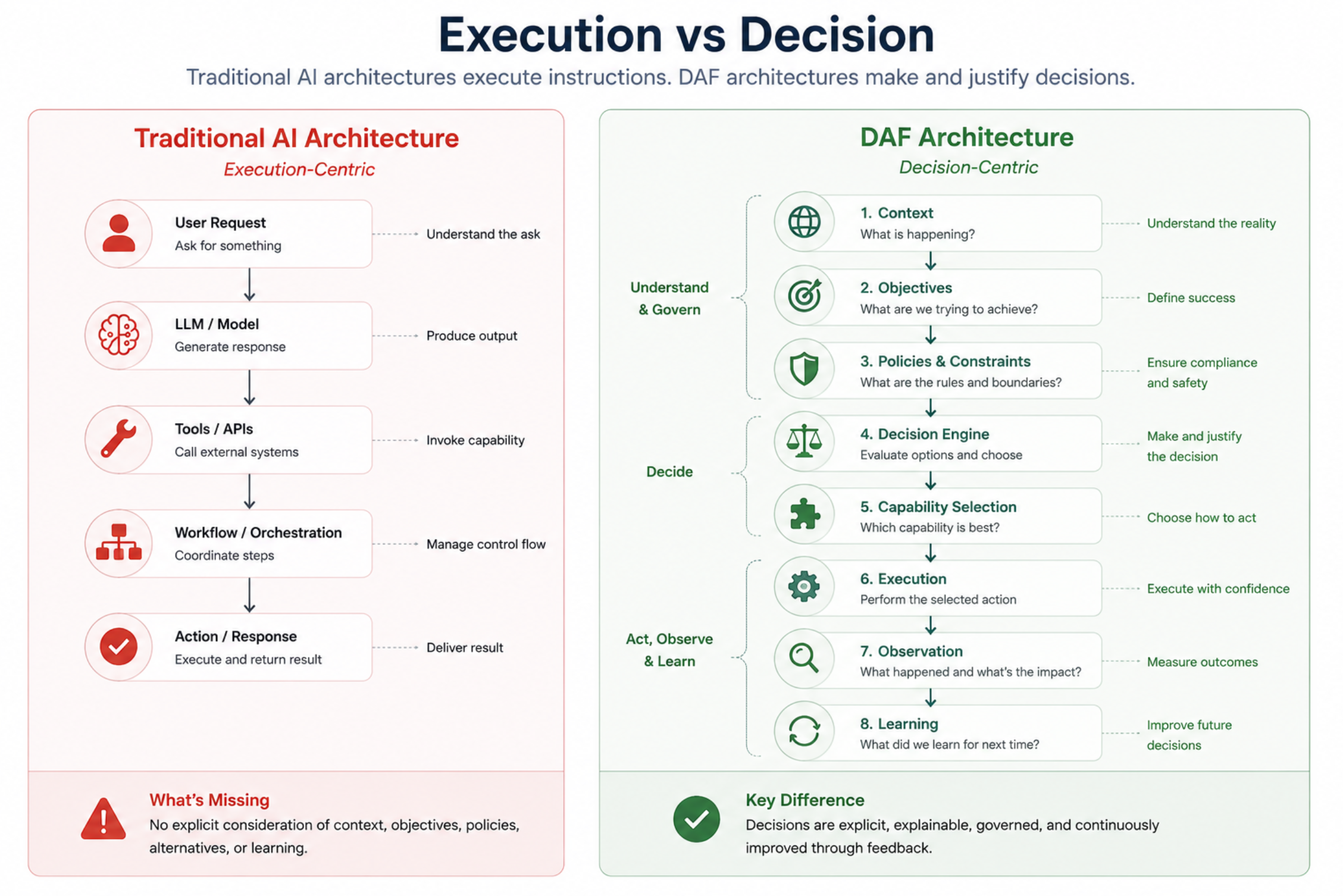
For decades, software architecture has focused mainly on execution. Business applications receive requests, evaluate predefined rules, invoke business services, update state, and return results. As long as business behavior could be anticipated in advance, that approach worked well, and organizational knowledge lived in application code, workflows, and rule engines that stayed relatively stable over time.
AI changes that relationship. Instead of encoding every business decision directly into software, organizations now expect systems to evaluate changing contexts, balance competing objectives, interpret incomplete information, respect organizational policy, operate inside acceptable risk boundaries, and adapt continuously as circumstances shift. The architectural challenge has moved from executing work efficiently to deciding which work should happen in the first place, and that's a real shift in how software gets built.
Execution has been studied for decades through layered architectures, service-oriented systems, event-driven platforms, and cloud-native design. Decision-making has rarely been treated as its own architectural concern because software historically relied on deterministic rules that developers wrote directly. AI breaks that assumption. When software starts making decisions dynamically instead of executing predefined logic, decision-making itself becomes part of the architecture.
The industry has poured effort into better language models, richer prompts, more capable orchestration frameworks, larger context windows, and increasingly sophisticated agent platforms. All of that is valuable, and all of it is still focused on execution. Comparatively little attention has gone into the architectural discipline that governs how intelligent systems perceive reality, evaluate competing objectives, apply organizational policy, select the right capability, justify their behavior, and improve through operational feedback.
Organizations building AI have reached exactly that boundary. The intelligent systems built over the next few years won't be defined primarily by bigger models or more sophisticated agents. They'll be defined by the quality of the decision systems that govern them.
The Missing Layer: Why Current AI Systems Confuse Execution With Decision-Making
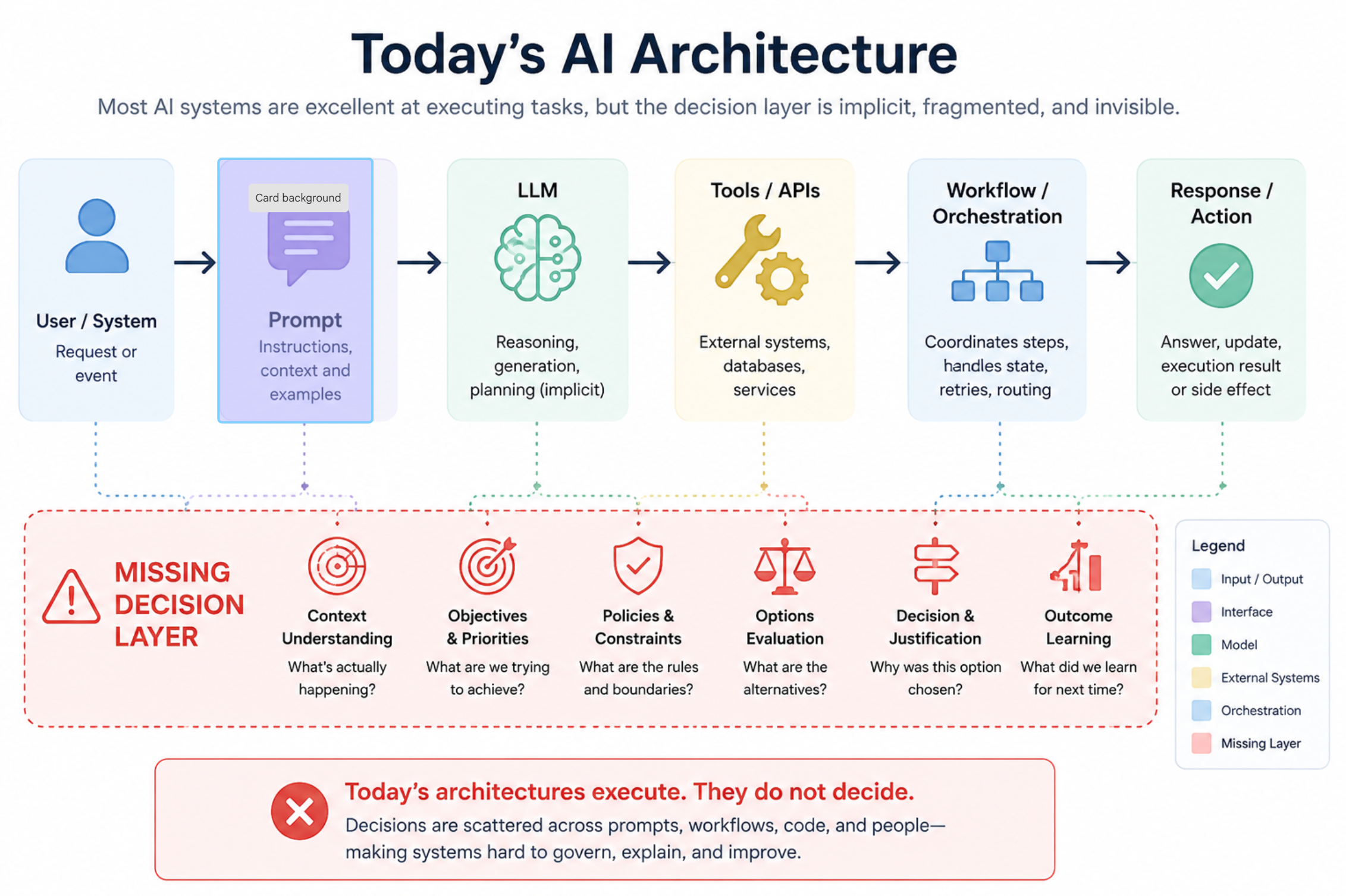
Most production AI architectures follow a similar pattern regardless of the technology stack. A language model receives a prompt describing the user's objective. An orchestration framework coordinates interactions between external systems. APIs expose business capabilities like creating tickets, querying databases, deploying infrastructure, or generating reports. Retrieval, memory, authentication, and observability components round it out. Collectively, organizations call this an AI agent.
From a software engineering perspective, this looks entirely reasonable. Every necessary capability seems to exist. The system understands natural language, invokes business services, maintains conversational state, and runs increasingly complex workflows. The question that turns out to be surprisingly hard to answer is a simple one: where does the actual decision occur?
That question gets overlooked because modern language models produce responses that resemble reasoning. The outputs look thoughtful, contextual, and adaptive, which creates the impression that decision-making emerges naturally from the model itself. But reasoning isn't the same as decision-making. Reasoning explores possible alternatives. Decision-making selects a single course of action that satisfies organizational objectives, policies, and acceptable risk. That's a bigger job than language generation alone can do.
Consider a cloud operations platform responsible for production infrastructure across multiple regions. Monitoring detects increased latency in a customer-facing service. Several actions are technically valid: provide more infrastructure, restart instances, reroute traffic, roll back the latest deployment, notify engineering, or keep monitoring while more telemetry comes in. Every one of those actions is executable. The architectural challenge is figuring out which one actually serves the organization's objectives, and answering that requires far more context than a prompt can realistically hold.
Has another deployment recently started? Is this expected because of a scheduled marketing campaign? Are cost optimization policies currently restricting automatic scaling? Does organizational policy prohibit infrastructure changes during business hours? Is the affected service business-critical? Has engineering already acknowledged the incident?
None of these questions belong naturally inside a prompt, and they shouldn't be buried inside workflow definitions, conditional statements, or application code either. They represent organizational decision knowledge.
Today, most production AI systems scatter that knowledge across implementation layers: some policy lives in prompts, some in workflow engines, some in authorization systems or feature flags, and operational context is spread across monitoring platforms, enterprise databases, cloud APIs, and business applications. The language model ends up responsible for assembling fragments of organizational knowledge that were never designed to function as a coherent decision system.
That fragmentation creates an architectural illusion. These systems look autonomous, but they're really sophisticated execution engines running without an explicit model for decision-making. The distinction matters more as AI expands beyond isolated assistants into financial operations, infrastructure management, cybersecurity, software engineering, healthcare, logistics, and regulatory compliance. Execution is about how an action gets performed. Decision-making determines what should happen next, given everything the organization currently knows.
Modern AI has become genuinely good at answering the first question. The second one remains largely undefined.
The Decision Architecture Framework
The Decision Architecture Framework (DAF) proposes that decision-making should become a first-class architectural concern, independent of both implementation and AI itself. Rather than treating intelligent behavior as something that emerges from prompts or language models, DAF treats decisions as architectural assets that can be designed, governed, observed, improved, and reused across systems.
That's a real shift in perspective. Traditional software architecture organizes systems around execution: how requests flow through applications, services, databases, workflows, and infrastructure. Decision Architecture organizes systems around organizational behavior instead.
Its purpose is to make sure every meaningful action results from an explicit evaluation of context, objectives, policies, constraints, available capabilities, and expected outcomes before execution ever begins.
The canonical definition: Decision Architecture Framework (DAF) is an architectural discipline that explicitly models how software systems perceive context, evaluate objectives, apply organizational policies, select capabilities, execute actions, observe outcomes, and continuously improve future decisions through operational feedback.
A few things about that definition are worth calling out directly. Decision Architecture is not an AI framework. AI makes the need for it obvious, but the framework applies to any software system whose behavior depends on evaluating changing context rather than executing predetermined logic. It also doesn't replace existing architectural styles.
Layered architectures, event-driven systems, microservices, cloud-native platforms, workflow engines, and orchestration frameworks stay essential. DAF adds a concern that governs how those components collaborate once decisions become dynamic instead of deterministic. And it deliberately separates organizational behavior from technical implementation: applications stay responsible for executing specialized capabilities, while the architecture becomes responsible for deciding when those capabilities participate, under what conditions, and how their outcomes feed future organizational knowledge.
The Principles of Decision Architecture
Every architectural discipline is ultimately defined by a small set of principles that remain stable even as technologies evolve. DAF is founded on six principles.
1. Decisions are architectural assets.
Decisions should be designed explicitly rather than emerging implicitly from prompts, workflows, or application code.
2. Context precedes reasoning.
Intelligent behavior depends first on understanding the operational reality in which a decision is made. Reasoning without sufficient context produces sophisticated guesses rather than reliable decisions.
3. Objectives guide decisions.
Every decision exists to optimize one or more organizational objectives. Policies and constraints shape behavior, but objectives determine what success means.
4. Capabilities provide the means for execution, while organizational intelligence emerges from the decisions governing their use.
APIs, applications, workflows, AI models, and implementation skills provide capabilities. They should not determine organizational behavior independently.
5. Every decision must be observable.
Organizations should understand not only what actions occurred but also why those actions were selected, which alternatives were rejected, and how outcomes influence future decisions.
Every execution produces new organizational knowledge. That knowledge should become part of future context, allowing decision quality to improve over time.
Together, these principles establish Decision Architecture as more than another implementation framework.
They define a discipline for designing intelligent enterprise systems whose behavior remains explainable, governable, reusable, and continuously improvable regardless of the underlying technologies.
A Formal Vocabulary for Decision Architecture
Architectural disciplines mature once they establish a shared language. Just as services, events, aggregates, repositories, and bounded contexts gave architects a precise way to talk about earlier generations of software, Decision Architecture introduces its own vocabulary.
A Decision is an explicit evaluation that selects one course of action from multiple alternatives, according to organizational objectives. Context is the complete operational reality available at the moment a decision is evaluated, including business state, historical knowledge, environmental signals, and organizational memory. Objectives define the outcomes the organization wants to optimize and give every decision its direction.
Policies express organizational intent by defining acceptable behavior independently of technical implementation. Constraints set the operational, regulatory, financial, or technical boundaries within which decisions have to operate. A Capability is any technical function that enables execution, whether it's implemented through software, APIs, enterprise applications, workflows, or AI-powered components.
A Skill is a specialized capability, often AI-enabled, built to perform a narrowly defined implementation task, like generating infrastructure code, reviewing architecture, analyzing security posture, or producing documentation. Execution turns a selected decision into observable action inside enterprise systems. Instrumentation captures the full lifecycle of every decision, making behavior explainable and measurable. And Learning folds execution outcomes back into future context, so organizational behavior keeps evolving through operational experience rather than staying frozen in static implementation.
These concepts are the foundation the rest of this series builds on: decision lifecycles, decision graphs, implementation skills, migration strategies, governance, and reference architectures for intelligent enterprise systems.
This first paper makes one central point. Execution is no longer the hardest architectural problem AI presents. Designing systems that consistently make good decisions is.
The Decision Lifecycle: Understanding How Intelligent Decisions Emerge
One of the most persistent misconceptions about enterprise AI is that decisions happen the moment a language model produces an answer. That's understandable, since the model is the most visible part of the system. It receives a prompt, generates a response, and often appears to reason through complex situations, which makes it tempting to treat that response as the decision itself.
In practice, organizations rarely make decisions that way. Watch how an experienced engineer responds to a production incident. They don't glance at one metric, grab the first available action, and modify a production environment on the spot. They spend time understanding what's actually happening: correlating infrastructure telemetry with recent deployments, checking historical incidents, verifying whether maintenance windows are active, weighing customer impact, reviewing operational policy, and talking to colleagues before choosing a course of action. Most of that work has nothing to do with execution. It's the process of building an accurate understanding of reality before taking any action at all. AI systems operating in production should follow the same principle.
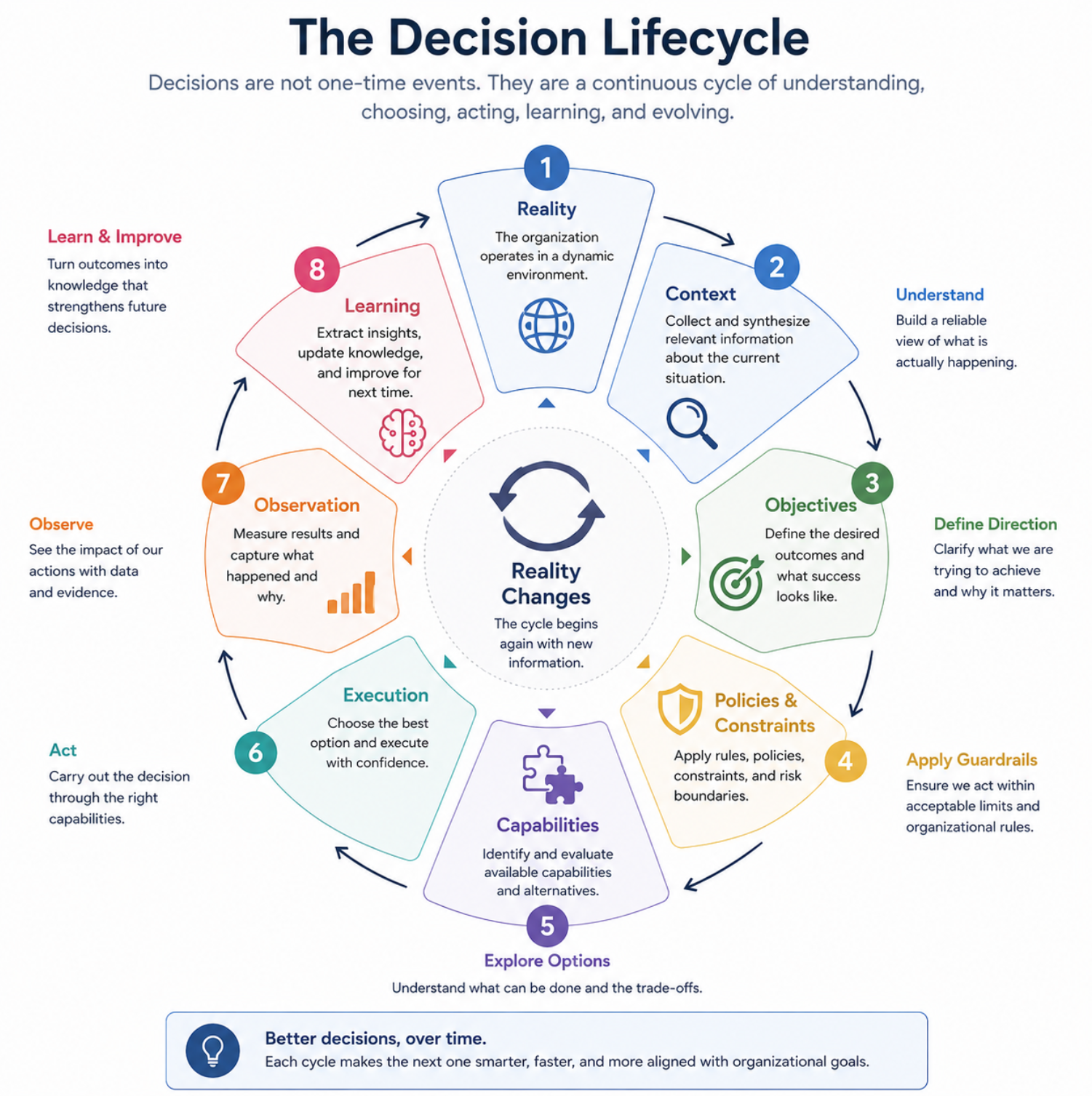
Decision Architecture treats every decision as a lifecycle, not a single event. The lifecycle starts well before an API gets invoked or a model generates a recommendation, and it continues long after execution finishes, because every outcome becomes additional organizational knowledge. Intelligence isn't concentrated in one model invocation. It comes from the interaction between contextual understanding, organizational objectives, governance, specialized capability, execution, observation, and continuous learning.
Understanding this lifecycle matters more than understanding any single implementation technology, because the lifecycle stays remarkably stable even as language models, orchestration frameworks, and development tools keep changing.
Decisions Begin With Understanding Reality
Imagine a global retailer running hundreds of Kubernetes clusters across multiple cloud providers. During a major promotional event, dashboards suddenly show CPU utilization above ninety percent across several production clusters.
Viewed in isolation, this looks straightforward. High utilization suggests insufficient compute capacity, and conventional automation would almost certainly respond by scaling horizontally. Plenty of AI systems would reach the same conclusion after summarizing the metrics. An experienced platform engineer, though, would rarely act on that immediately. They'd start asking broader questions first.
Has a deployment just started? Is another region already absorbing traffic? Did marketing launch a campaign that would generate unusual demand? Are similar utilization patterns showing up across unrelated services? Have FinOps teams temporarily restricted infrastructure expansion for budget reasons? Has engineering already flagged a memory leak that's making the utilization numbers unreliable?
None of those questions is about execution. They're about understanding reality. Decision Architecture formalizes this by treating context as the architectural representation of everything the organization currently knows about a situation. Context reaches well beyond conversation history or retrieved documents. It includes operational telemetry, historical behavior, organizational memory, business events, customer commitments, engineering activity, compliance requirements, and institutional knowledge built up over years of running complex systems.
This distinction changes the quality of every decision that follows. The same language model, handed a different contextual reality, shouldn't just produce a different response. It should arrive at a different organizational conclusion because the environment the decision lives in has actually changed.
Every Decision Optimizes Competing Objectives
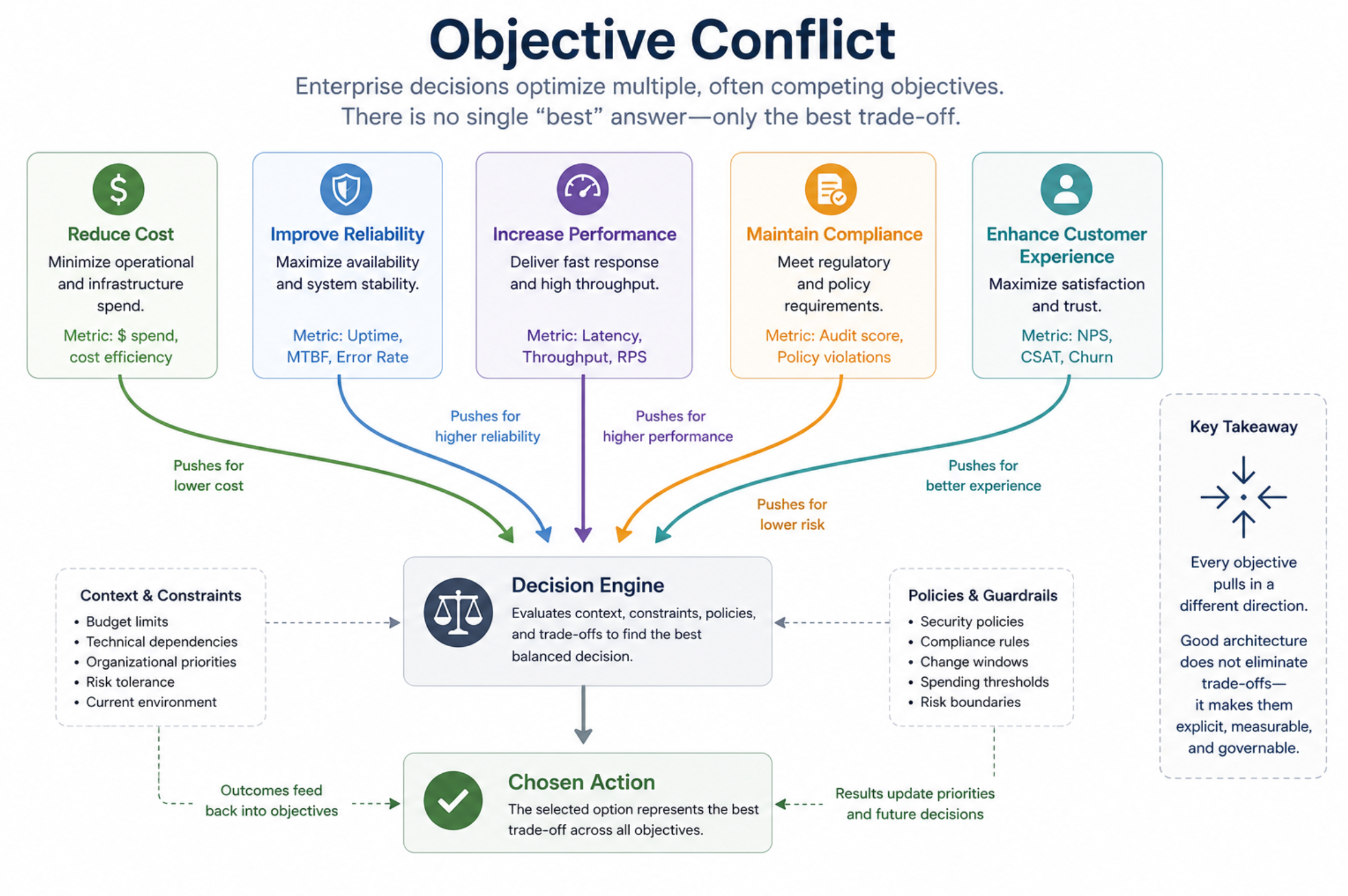
Once reality is established, another challenge shows up immediately. Organizations rarely pursue a single objective, especially in enterprise environments where operational, financial, regulatory, and customer considerations regularly compete with each other.
Back to the cloud operations example: increasing infrastructure capacity might improve application performance, but it also raises operational costs. Delaying that expansion might satisfy FinOps goals while risking customer experience. Rolling back a deployment might restore stability quickly but delay a business-critical release. Waiting for more telemetry might avoid an unnecessary change but extend an ongoing incident. Which alternative is right depends entirely on which objectives the organization considers most important in that specific context.
This exposes a real limitation in a lot of current AI implementations. Prompts describe the task to complete, but they rarely communicate the strategic objectives that define organizational success. A request like "optimize infrastructure costs" sounds simple until it collides with availability targets, customer commitments, regulatory obligations, or engineering productivity goals. Decision Architecture separates objectives from instructions: objectives describe the outcomes an organization wants, not the actions a system should perform. Because objectives exist independently of implementation, they can evolve as business priorities change without forcing a redesign of applications or workflows.
Policies Turn Objectives Into Organizational Behavior
Objectives alone can't determine behavior because organizations rarely optimize an outcome without also respecting boundaries. Every enterprise operates under explicit and implicit policies built up through years of operational experience. Some of it comes from external regulation. Some reflect governance, financial controls, security requirements, or engineering practice. Together, this policy defines not just what an organization wants to achieve, but how it's willing to go about achieving it.
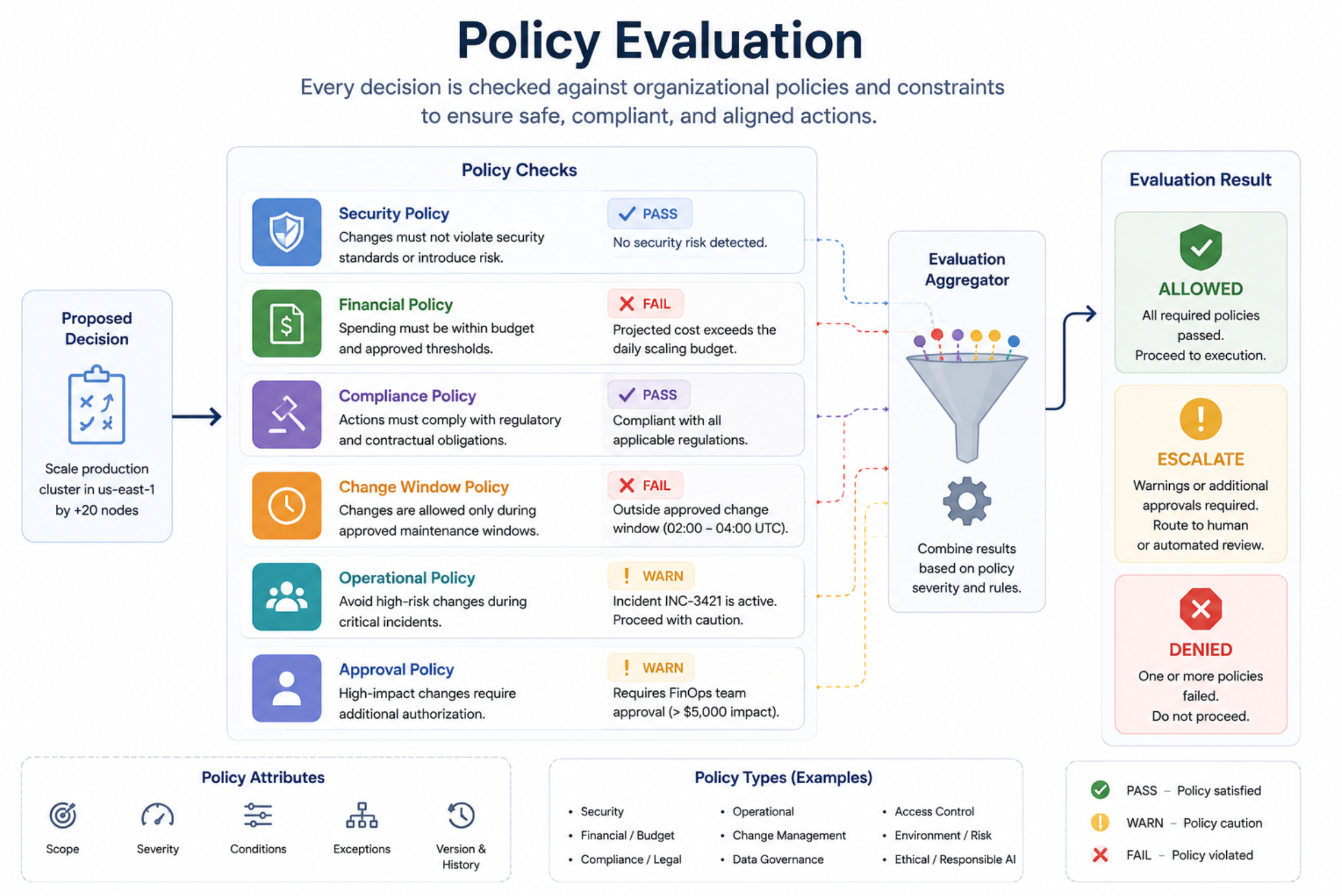
Back to the cloud operations platform: suppose the architecture decides that scaling production infrastructure would improve customer experience. Before that action executes, policy can still shape the outcome. Infrastructure changes might be prohibited during active deployments. Scaling past a financial threshold might require authorization. Customer-facing services might take priority over internal workloads. High-risk changes might need human approval outside a defined maintenance window.
These policies exist because organizations deliberately balance optimization against governance, not because automation itself is technically hard. Decision Architecture treats policy as a reusable architectural asset rather than something scattered across prompts, workflow definitions, feature flags, or application code, so organizational behavior stays explicit, explainable, and consistently reusable no matter which application, model, or technology eventually executes it.
Capabilities Implement Decisions Rather Than Define Them
Only after reality is understood, objectives evaluated, and policy applied does the architecture turn to execution. This is arguably the most important conceptual move in Decision Architecture.
Most discussions of AI agents start by cataloging available tools. Can the agent access Kubernetes? Can it run Terraform? Can it create Jira tickets? Can it modify production infrastructure? Those are technical capability questions, and they say remarkably little about intelligent behavior, because every experienced engineer knows the ability to perform an action doesn't mean performing it is the right call.
Decision Architecture reframes business applications, APIs, AI models, orchestration frameworks, and implementation technologies as organizational capabilities rather than autonomous actors. Each one contributes specialized expertise. None of them independently determines organizational behavior. A Terraform engine provisions infrastructure. A deployment pipeline releases software. Claude Code generates implementation changes. An observability platform analyzes telemetry. A documentation system produces technical reports. Each does its specialized job, and the architecture decides when and under what conditions that job gets invoked.
Execution, Observation, and Learning Become One Continuous Process
Once the right capability is selected, execution is comparatively straightforward: infrastructure changes apply, software deploys, documentation is generated, customers get notified, or engineering gets alerted. Within Decision Architecture, though, execution marks the start of organizational learning, not the end of the decision process.
Traditional software engineering has long relied on logging, tracing, metrics, and monitoring for observability. Intelligent systems need a richer version of that because understanding outcomes means understanding decisions, not just recording actions. Say the cloud operations platform decides not to provision additional infrastructure because contextual analysis suggests elevated utilization is coming from a deployment that will finish in fifteen minutes. If response times stabilize on their own, the organization gains confidence that delaying execution was the right call. If performance instead gets worse, engineering can conclude that the contextual assumptions were incomplete or the policy threshold needs work.
That feedback value extends beyond the individual incident. Every observed outcome becomes organizational knowledge that shapes future decisions. Context gets richer, policy gets more precise, objectives evolve, confidence builds, and the architecture develops a more sophisticated understanding of the environments it operates in. The decision lifecycle doesn't end with execution. It reinforces itself through operational learning.
Decision Architecture in Practice: An Evolving Cloud Operations Platform
Every architectural framework faces the same test: do its abstractions hold up once real operational complexity shows up? Architectural diagrams tend to look elegant because they leave out the ambiguity that defines production systems. Enterprise environments rarely offer isolated problems. Multiple events happen at once, priorities shift continuously, and every decision has consequences that extend well past the immediate technical task. That's why Decision Architecture is easier to grasp through a single evolving example than a collection of unrelated ones.
Picture a multinational retailer running digital commerce platforms across AWS and Azure. Hundreds of Kubernetes clusters support customer-facing applications, internal business systems, machine learning workloads, and global supply chain operations. Engineering already has mature observability, Infrastructure as Code, GitOps pipelines, FinOps dashboards, incident management, and AI-powered implementation tools. Technologically, this organization is already sophisticated. Automation isn't the primary challenge anymore. Consistently making good operational decisions is.
Throughout a given day, dozens of situations come up that call for judgment rather than execution. A cluster's latency spikes. Cloud spend exceeds forecast. A deployment behaves unexpectedly. Regional demand jumps because of a marketing campaign. Security telemetry flags suspicious activity in a production workload. Each of these could trigger automation on its own. Instead, Decision Architecture treats each one as the start of a decision process, pulling in operational telemetry, historical incidents, business calendars, financial policy, security policy, engineering activity, and customer commitments before deciding on the right response.
Sometimes that means immediate infrastructure expansion is warranted, and sometimes it means waiting is the better call; some situations call for a rollback, others for more investigation before anything happens at all.
Interestingly, the technology doing the actual execution barely changes across any of these scenarios. Terraform keeps provisioning infrastructure. Kubernetes keeps orchestrating workloads. GitHub Actions keeps deploying software. AI-powered implementation skills keep generating code, documentation, and operational recommendations. What changes is the quality of the organizational decisions governing when those capabilities get used.
Over time, this distinction matters because organizations stop measuring automation by how many actions happen automatically and start measuring it by the quality of the decisions that precede those actions. That shift is the real move from automated infrastructure toward intelligent operations.
From Business Logic to Decision Systems
Perhaps the most far-reaching implication of Decision Architecture has nothing to do with today's AI agent conversation. It challenges one of the oldest assumptions in software engineering.
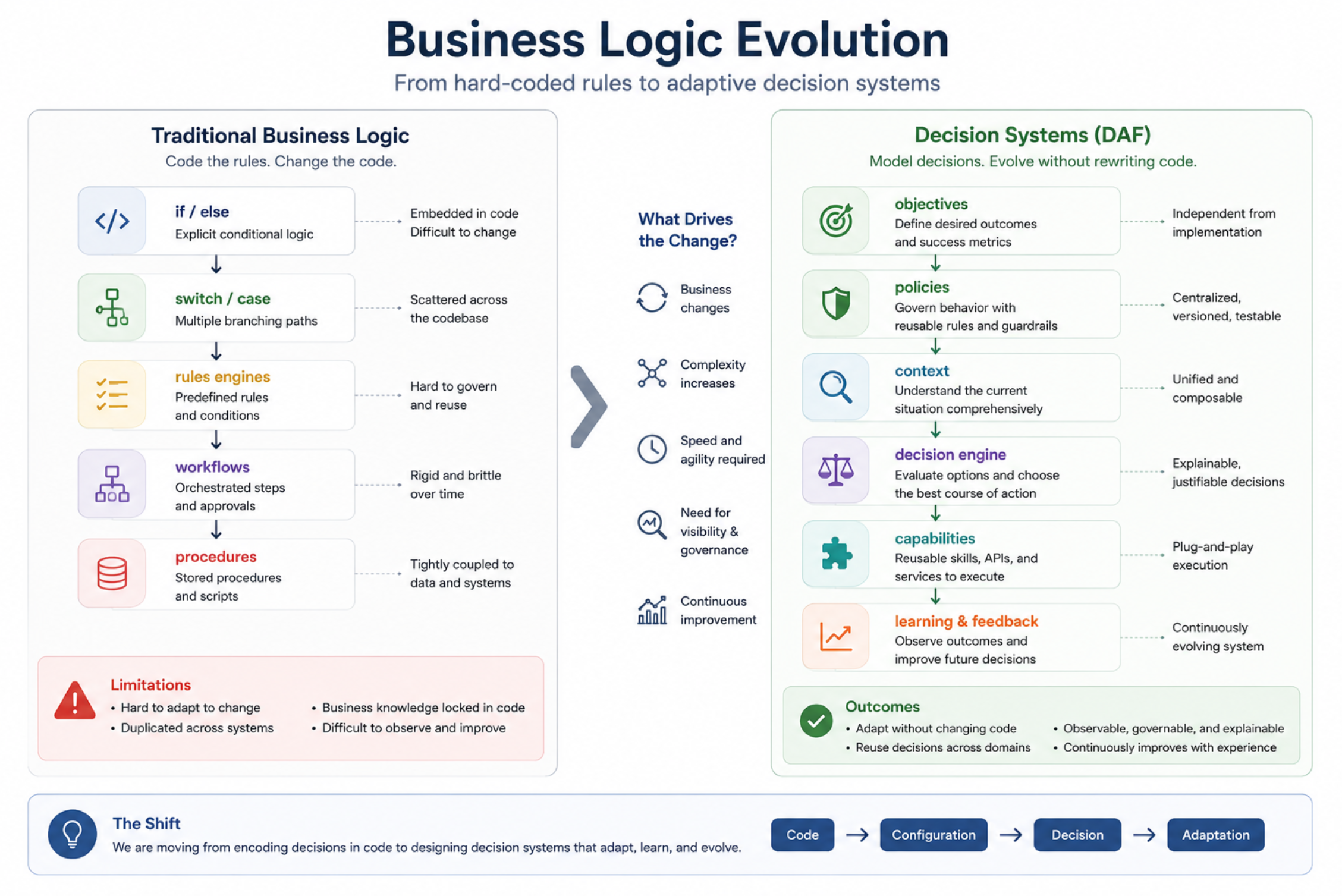
For decades, software has been built on a consistent principle: organizational knowledge eventually becomes application code. Business analysts describe policy, architects translate it into workflows, developers implement conditional logic, and enterprise systems execute those rules until requirements change. AI introduces another possibility. Instead of translating every business decision directly into software, organizations can represent objectives, governance policy, operational constraints, contextual understanding, institutional knowledge, and acceptable risk independently of execution. Applications keep providing capability, but responsibility for organizational behavior gradually migrates toward explicit decision systems.
This mirrors earlier architectural shifts. Service-oriented architecture separated business capability from monolithic applications. Cloud computing separates infrastructure from physical hardware. Event-driven architecture separates communication from direct dependency. Decision Architecture separates organizational behavior from implementation.
That separation has consequences well beyond AI. Applications become more modular because they no longer own business judgment. Policy becomes a reusable architectural asset instead of duplicated implementation logic. Objectives evolve independently of applications. Capabilities become composable across domains. Institutional knowledge becomes observable, measurable, and continuously improvable.
The bigger consequence, though, is how architects think about software itself. For decades, we've described applications by the function they perform: billing systems, customer management systems, deployment platforms, monitoring tools, procurement systems. Decision Architecture points toward a different picture, one where organizational software becomes an ecosystem of specialized capabilities participating in shared decision systems. If earlier generations of software engineering taught us how to structure code, distribute services, and scale infrastructure, this one may end up being remembered for teaching us how to architect decisions.
Reference Architecture: Designing Enterprise Systems Around Decisions
An architectural framework earns its keep by giving architects a stable mental model they can apply across different domains, not by prescribing specific technologies. It identifies the fundamental responsibilities every system has to satisfy, regardless of whether it's built with microservices, event-driven platforms, workflow engines, AI models, or something that hasn't been invented yet.
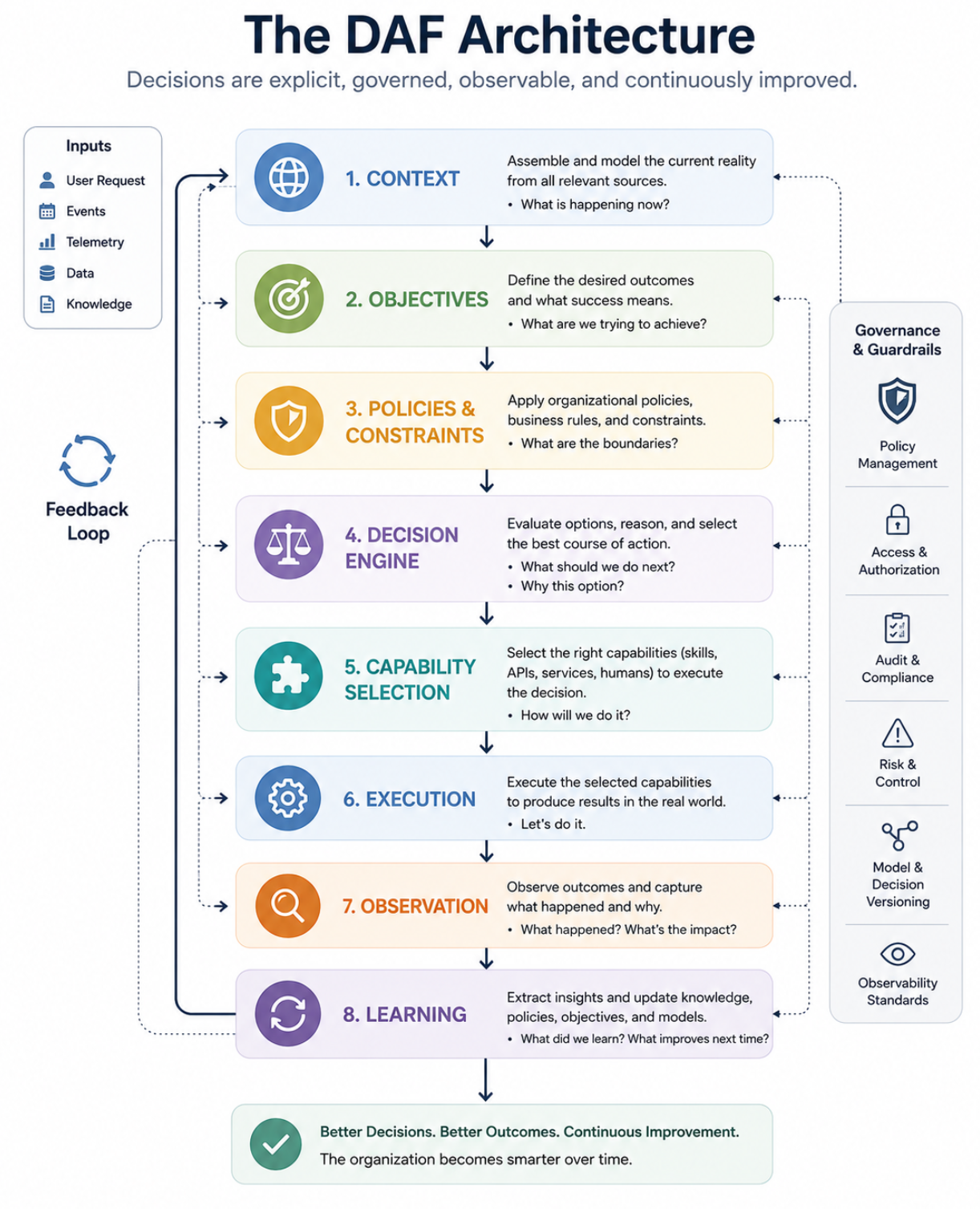
Decision Architecture follows that same philosophy. Rather than organizing software around applications, services, or agents, it organizes enterprise systems around the lifecycle of organizational decisions. Every architectural component exists to answer one question: how should the organization decide what to do next?
The first responsibility of the architecture is to build a reliable representation of reality: a contextual model that combines operational telemetry, business events, customer information, historical behavior, organizational memory, infrastructure state, and external signals into a coherent view of the environment in which the decision will happen. Context isn't a cache of retrieved documents or a bigger prompt window. It's the architectural representation of what the organization currently understands to be true.
Once context is established, the architecture evaluates organizational intent. Objectives define the outcomes the enterprise wants to optimize, while policy, regulatory requirements, financial constraints, and governance rules describe the conditions under which those objectives can be pursued. Rather than embedding any of this inside prompts, workflow definitions, or application code, Decision Architecture treats it as a reusable architectural asset, independent of implementation.
Only after context, objectives, and governance have all been evaluated does the architecture decide which capabilities should participate in execution. Applications, APIs, cloud services, workflow engines, AI-powered skills, and enterprise platforms become participants in the decision process rather than autonomous decision-makers. Their job is to execute specialized work. The job of choosing that work belongs to the architect.
Execution isn't the end of the process either. Every meaningful action produces additional organizational knowledge. Observability captures not just operational outcomes but the contextual assumptions, policy evaluations, confidence levels, implementation choices, and business consequences behind each decision, and that information feeds back into future context so later decisions benefit from accumulated experience.
Taken as a whole, this reference architecture forms a continuous feedback system rather than a linear pipeline. Context informs decisions, decisions govern execution, execution produces outcomes, and outcomes enrich organizational knowledge. The architecture evolves continuously as the organization itself learns, and no single technology sits at its center. Language models, orchestration frameworks, cloud platforms, business applications, implementation skills, and workflow engines all remain replaceable. The architecture stays stable because it's organized around decisions, not technology.
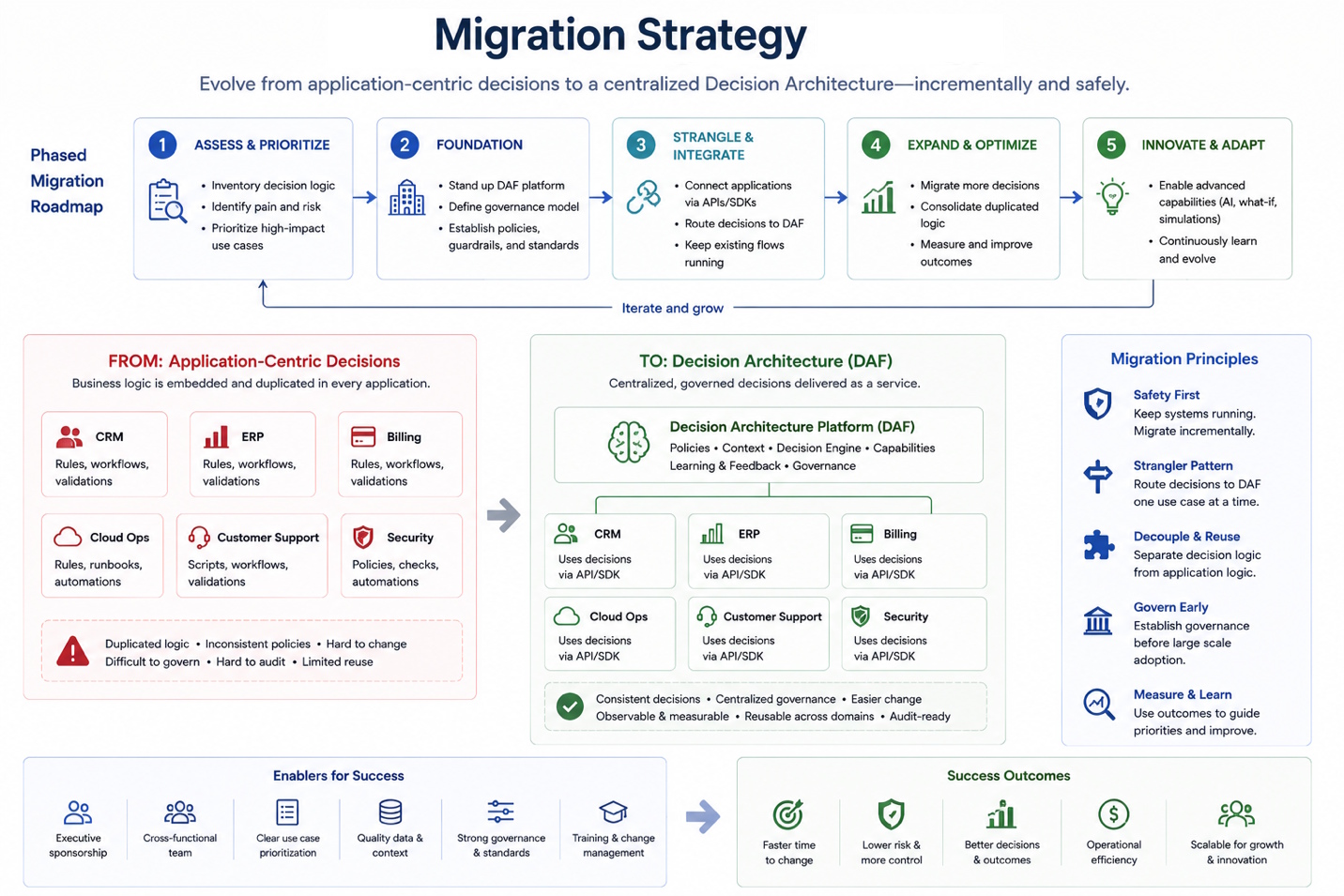
Migration Strategy: Evolving Enterprise Systems Rather Than Replacing Them
Architectural change rarely succeeds when it asks an organization to abandon existing investment. Most organizations run software portfolios built up over many years, spanning multiple generations of technology and shifting priorities. Any framework that assumes a greenfield environment ends up academically interesting and operationally irrelevant.
Decision Architecture assumes the opposite. Organizations should move toward decision-oriented systems incrementally, keeping existing applications while progressively relocating organizational behavior from implementation into architecture. This typically starts with systems that already rely heavily on deterministic business logic: approval workflows, operational runbooks, cloud automation, customer support processes, infrastructure management, and delivery pipelines, all of which usually contain large collections of conditional statements encoding years of organizational knowledge. Rather than replacing these systems with AI agents outright, organizations can start by identifying where the important decisions currently live and making them explicit.
That first stage is about visibility, not automation. Teams document existing decision points, identify what contextual information actually influences those decisions, catalogue the applicable business policy, and pin down the objective each decision is trying to optimize. This exercise usually surfaces just how fragmented organizational knowledge already is, spread across applications, workflow engines, documentation, operational procedures, and individual teams.
Once decisions are visible, organizations can start separating them from implementation. Existing applications keep providing capability exactly as before, while decision services gradually take over responsibility for selecting when and how those capabilities participate. The existing software actually becomes more valuable because its responsibilities get more focused: applications execute specialized work, and decision systems coordinate organizational behavior.
AI capabilities start adding real value only after this separation exists. Language models stop replacing business logic directly and instead participate in an explicit decision framework where context, objectives, governance, and observability already exist. AI becomes one contributor to organizational intelligence rather than the sole source of decision-making. The migration resembles earlier transitions, like the move from monolithic applications to service-oriented architecture or from on-premises infrastructure to cloud-native platforms. Organizations keep delivering business value throughout, while gradually raising the architectural sophistication of their systems.
Decision Architecture is evolutionary, not revolutionary. It doesn't replace business systems. It reorganizes their responsibilities.
Design Principles, Patterns, and Anti-Patterns
As any architectural discipline matures, it develops patterns that reliably produce good outcomes and anti-patterns that reliably introduce unnecessary complexity. Decision Architecture is no exception.
A few design principles fall naturally out of the framework. Organizations should avoid embedding organizational judgment inside prompts, workflow definitions, orchestration logic, or application code whenever that judgment is expected to evolve independently of implementation, and treat decision-making as an explicit architectural concern instead. Context matters more than raw reasoning power: a lot of current AI discussion focuses on making reasoning more sophisticated, but reasoning quality is fundamentally bounded by contextual quality, so improving organizational understanding usually beats increasing model sophistication.
Capabilities and intelligence aren't the same thing either. Enterprise applications, APIs, implementation skills, workflow engines, and AI models are capabilities contributing specialized expertise, not autonomous decision-makers, and their value comes from participating in a well-designed decision system rather than acting alone. And observation deserves to be treated as a first-class concern: every meaningful decision is a chance to improve future ones, which means observability needs to extend beyond technical telemetry into decision telemetry, capturing not just what happened but why, what alternatives were rejected, and how understanding evolved.
From these principles, a few recurring patterns show up in practice: shared contextual models that reduce fragmentation across systems, centralized policy management that keeps organizational behavior consistent, specialized implementation skills that encourage modular expertise, decision traces that improve governance and auditing, and feedback loops that turn operational outcomes into organizational learning.
The anti-patterns are just as recognizable. Prompt-centric architecture is what happens when organizational behavior gradually migrates into increasingly complex prompts that become nearly impossible to govern, test, or maintain. Agent sprawl shows up when organizations spin up numerous isolated agents that each implement a slightly different interpretation of similar business policy, and over time those agents diverge, duplicate capability, and drift out of consistency with each other.
Tool-centric design happens when systems get evaluated by how many capabilities they expose rather than the quality of the decisions governing their use, which usually just adds operational risk without improving decision quality. And invisible decisions happen when organizations log only inputs and outputs while losing the contextual assumptions, policy evaluations, and reasoning behind them, leaving nothing to explain, govern, or systematically improve.
Naming these patterns and anti-patterns is what turns Decision Architecture from a conceptual idea into a practical engineering discipline.
Conclusion: Decision Systems as the Next Architectural Abstraction
Every major transition in software engineering has come with a new architectural abstraction that lets developers separate concerns previously treated as inseparable. Structured programming separated algorithms from uncontrolled execution. Object-oriented design separated behavior from procedural implementation. Service-oriented architecture separated business capability from monolithic applications. Cloud computing separated infrastructure from physical hardware. Event-driven architecture separates communication from synchronous dependency.
AI is introducing another one. For decades, software has been built by translating organizational decisions directly into implementation: business policy became conditional statements, approval processes became workflow definitions, operational procedure became automation scripts. Enterprise applications accumulated not just technical capability but the organizational judgment governing when to use it. Decision Architecture proposes separating those two things, letting capabilities keep executing specialized work while decision systems take on responsibility for governing organizational behavior.
This may end up mattering more than any single advancement in language models, because it changes where architects locate intelligence inside enterprise systems. Intelligence stops living primarily inside applications or foundation models. It comes from the interaction between contextual understanding, organizational objectives, governance, specialized capability, continuous observation, and institutional learning.
If that's right, the current conversation around AI agents is only the start of a bigger architectural transition. The long-term impact of AI won't be measured by how many autonomous agents an organization deploys or how sophisticated its individual models are. It'll be measured by the quality of the decision systems coordinating enterprise behavior across increasingly complex technology.
Decision Architecture is offered here as a starting framework for that transition, not a final definition. Like every architectural discipline before it, it will evolve through implementation experience, operational failures, and contributions from practitioners across industries. Its value will come down to whether it helps organizations build systems that make consistently better decisions while staying explainable, governable, and adaptable, not the terminology introduced in this paper.
The intelligent systems organizations build over the next few years won't be defined by applications that execute business logic more efficiently or by agents wielding increasingly sophisticated tools. They'll be defined by architectures that make organizational decision-making an explicit, observable, reusable, and continuously improving capability. That, more than any single advancement in AI, may turn out to be the next major abstraction in software engineering.
If your AI agents are executing perfectly and still landing on the wrong call, that's exactly the kind of architecture gap CloudZone maps out for customers building on AWS. Book a Claude on AWS architecture review.
FAQs
What is the Decision Architecture Framework (DAF)?
DAF is an architectural discipline that treats decision-making as its own explicit layer, separate from execution. It models how systems perceive context, apply objectives and policy, select capabilities, execute, and learn from outcomes, rather than letting decisions emerge implicitly from prompts or code.
How is a "decision" different from a language model's reasoning?
Reasoning explores possible alternatives, but a decision selects one course of action based on organizational objectives, policy, and risk. A model producing a thoughtful-looking response is still just reasoning until that broader evaluation happens.
Why can't objectives alone determine what a system should do?
Objectives describe desired outcomes, but organizations also operate under policy and constraints that shape how those outcomes can be pursued. A decision might serve an objective and still be blocked by policy, such as a change being restricted during an active deployment or requiring approval past a cost threshold.
Do capabilities like APIs, workflows, or AI models make decisions themselves?
No. DAF treats them as capabilities that execute specialized work once a decision has already selected them, not as autonomous decision-makers. A Terraform engine provisions infrastructure and a deployment pipeline releases software, but neither one decides whether that action should happen.
Does adopting Decision Architecture mean replacing existing systems?
No. DAF is evolutionary rather than revolutionary. Organizations keep their existing applications and workflows, and progressively make already-existing decision points explicit and separate from implementation, rather than rebuilding everything around AI agents from scratch.
More from CloudZone
Danny Farber
September 1, 2026
Decision Architecture Framework (DAF): The Missing Layer Between AI and Enterprise Software
Software has always been built by encoding decisions into code. Artificial intelligence gives us the opportunity to separate decision-making from implementation for the first time.
AI
Or Dotan
August 11, 2026
24/7 Cloud Operations: The Four Levels Nobody Explains
Every managed cloud provider advertises 24/7 coverage. Almost none of them mean the same thing by it.
At one end, "24/7" means an alert fires at 3 AM, a system routes it to your inbox, and a human reads it when the business day starts.
MSP
Nir Shiloni
August 4, 2026
RAG, Fine-Tuning, or Prompt Engineering: Choosing the Right Approach
Picture a meeting room. Laptops open, screens flickering, everyone with that particular gleam in their eye. The first word in the air isn't "hello," it's "AI." And then comes the moment that always arrives: someone says, with total confidence, "We want ChatGPT. But ours. Now."









.png)





.png)