Cloud Managed Service Provider: When Is It Time for Your Startup to Make the Move?
June 18, 2026
Table of contents
A practical decision guide for founders, CTOs, and growth leaders navigating the shift from self-managed infrastructure to a managed model
The Cloud Question Every Growing Startup Eventually Has to Answer
Most startups begin their cloud journey the same way: a small engineering team, a manageable set of cloud resources, and the confidence that they can handle infrastructure themselves. For a while, they are right.
Then growth happens. The team scales. The product adds complexity. Enterprise customers start asking about compliance. The cloud bill arrives, and nobody can fully explain it. A senior developer spends a week on an infrastructure issue instead of shipping features.
At this point, the question is no longer theoretical: Is self-management still the right model, or is it time to work with a cloud-managed service provider?
This guide is built for the people who have to answer that question - founders weighing cost and control, CTOs thinking about technical debt and team capacity, and growth leaders who know that compliance is now a sales blocker.
What Does a Cloud-Managed Service Provider Really Mean?
A cloud-managed service provider is not just a vendor you call when something breaks. It is an ongoing operational partner that helps manage, monitor, optimize, and secure your cloud environment under a clear service-level agreement.
The difference is accountability. A one-time consultant may help design a solution. A reseller may help you purchase cloud services. An MSP stays involved after the setup is complete, making sure your cloud operations continue to run efficiently, securely, and reliably as the business grows.
That does not mean replacing your engineering team. Your developers still own the product, the application layer, and the technical roadmap. The MSP takes responsibility for the operational layer, so your team can spend less time managing infrastructure and more time building what creates value for customers.
The Three Stages of Startup Growth, and Where Does an MSP Start to Make Sense?
Most startups underestimate how quickly they move from stage one to stage two - and how much it costs when they wait too long to adapt their operational model. This is true whether you are running on AWS, Google Cloud, or a hybrid cloud environment.
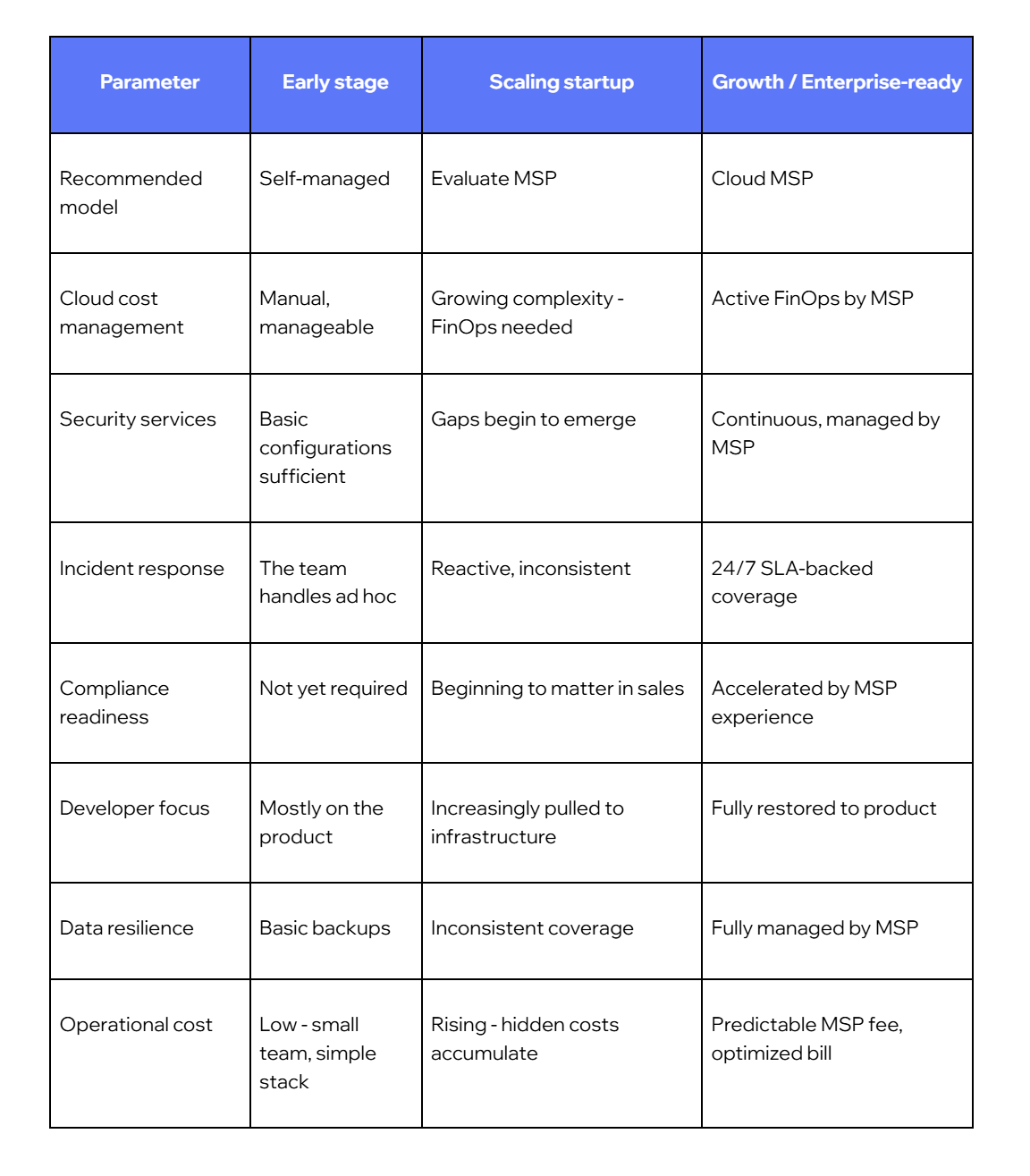
Early stage - Self-managed work. Small team, limited services, manageable complexity. Direct control makes sense. Cloud resources are predictable and easy to track.
Scaling - Warning signs appear. Team grows, complexity rises. Cloud costs drift. Developers absorb infrastructure tasks. Security services become harder to manage in-house. Compliance gaps begin to emerge.
Growth / Enterprise-ready - MSP becomes necessary. Enterprise sales require certifications. Cloud deployment decisions have real business consequences. FinOps and security need dedicated ownership.
7 Warning Signs It's Time to Move to a Cloud-Managed Service Provider
There is no single right moment to make the move. But there are patterns that repeat across startups that wait too long - and the cost is always higher than it needs to be. If several of the following apply to your situation, the managed cloud model deserves serious evaluation.
Infrastructure signals:
Your cloud bill grows without a clear reason. Month-over-month increases that nobody can fully attribute to business growth are a sign of cost sprawl - unused cloud resources, overprovisioned instances, and suboptimal purchasing decisions that compound over time.
Incidents are handled reactively, not proactively. If your team learns about infrastructure problems from customer monitoring alerts or, worse, from customer experience complaints rather than internal detection, you have a visibility gap. A cloud-managed service provider runs continuous monitoring with defined escalation paths - not just alerts when things break.
Security services are minimal or manual. Default cloud configurations are not a security posture. If nobody owns threat detection, access management reviews, and remediation workflows on an ongoing basis, the risk grows with every new service and team member added.
Nobody owns FinOps. Cloud cost optimization is a discipline, not a quarterly review. If there is no dedicated owner for rightsizing, Reserved Instance strategy, and Savings Plan analysis, you are almost certainly overpaying.
Team and business signals:
Developers are spending meaningful time on infrastructure. In lean teams, infrastructure work often falls to product engineers. The actual cost - in slowed product velocity and developer frustration - is significant and rarely reflected in financial models.
Compliance is becoming a sales blocker. SOC 2 Type II and ISO 27001 certifications are increasingly required in enterprise procurement. Building the required controls, documentation, and audit trails from scratch is a multi-month effort. A cloud-managed service provider with prior certification experience can significantly compress this timeline.
Hiring DevOps talent is proving difficult or expensive. Senior cloud engineers are among the most competitive hires in the market. If the search is taking longer than expected, or the cost is straining your hiring budget, an MSP delivers equivalent - and often deeper - expertise at a more predictable cost structure.
What a Cloud-Managed Service Provider Actually Does (and What It Doesn't)
What does a strong MSP deliver?
Continuous customer monitoring and incident response - 24/7 coverage with defined SLAs, not best-effort availability
Active FinOps - ongoing cost optimization including rightsizing underused cloud resources, identifying idle instances, and managing Reserved Instance and Savings Plan portfolios
Security services and posture management - continuous threat detection, access management reviews, and remediation workflows across your entire cloud ecosystem
Architecture guidance - access to senior cloud architects who have worked through scaling challenges across many companies and industries
Data resilience - backup strategies, disaster recovery planning, and business continuity frameworks that protect your critical workloads
Compliance acceleration - structured support for SOC 2, ISO 27001, and other certification processes, including control mapping, evidence collection, and audit preparation
Cloud migration and deployment support - whether you are completing a cloud migration or managing a complex cloud deployment across multiple environments, a cloud managed service provider reduces execution risk
Common myths - corrected:
"Working with an MSP means losing control of our infrastructure." In practice, MSP engagements are structured around transparency. Your team retains full visibility and decision-making authority over the application layer and architecture direction. The MSP manages operations - it does not override your engineering decisions.
"An MSP is only worth it for large enterprises." The economic case for a cloud-managed service provider is often strongest for scaling startups - precisely because the cost of building equivalent in-house capability is high relative to company size, and the risk of getting it wrong during a growth phase is significant.
"We'll bring in an MSP once we're bigger." This is the most common and costly misconception. Technical debt, security gaps, and cost inefficiencies compound over time. The earlier a cloud managed service provider establishes proper foundations, the lower the remediation cost later.
Head-to-Head Comparison: Self-Managed vs. Cloud-Managed Service Provider by Growth Stage
What to look for when choosing a cloud-managed service provider
Not all MSPs are equivalent. The right partner for a scaling startup looks different from the right partner for a large enterprise in steady state. Here is what actually matters:
Experience with fast-growing companies. Ask specifically about engagements with startups at a similar growth stage. Scaling challenges are different from steady-state enterprise operations. Your MSP should have seen them before.
Active FinOps methodology. Cost optimization should be a continuous process, not a quarterly report. Ask what their FinOps process looks like in practice: how often are recommendations made, how are savings tracked, and who is accountable for results.
Compliance track record. If SOC 2 or ISO 27001 is on your roadmap, ask directly: which certifications have they supported, which auditors have they worked with, and can they provide references?
Clear, contractual SLAs. Response time commitments should be specific and binding - not directional. Understand escalation paths, incident classification, and what happens when SLAs are missed.
Breadth across the cloud ecosystem. A strong MSP should be comfortable across multi-cloud and hybrid world environments - not locked into a single vendor. Whether your stack includes AWS, Google Cloud, or a hybrid cloud setup, your MSP should have the depth to support it.
Data resilience and backup strategy. Ask specifically how they approach disaster recovery and business continuity. This is an area where gaps are only discovered when it is too late.
Cloud deployment experience. If you are scaling infrastructure or entering new markets, ask about their cloud deployment methodology and how they manage environments at scale.
Certification and verified expertise. Look for recognized partner-tier status with major cloud providers. This is a meaningful quality signal, not just a badge.
The bottom line
Self-management is the right model for early-stage startups. The control is real, and when the team has the bandwidth and expertise, it is often the most efficient approach.
As a startup scales, that equation changes. The cost of DevOps headcount, the accumulation of technical debt, the drag on product velocity, and the compliance requirements of enterprise sales all push in the same direction. We live in a hybrid world where cloud-managed services are no longer a luxury - they are the operational foundation that lets engineering teams do their best work.
A well-chosen cloud managed service provider does not add bureaucracy - it removes the operational burden that was slowing you down.
CloudZone has helped growing international startups make exactly this transition - moving from self-managed infrastructure to a model where engineering teams focus on product while cloud operations scale reliably behind them. As a certified Premier Partner with deep FinOps, security services, and compliance experience, CloudZone brings the expertise and structure that scaling startups need from day one.
FAQs
What is a cloud-managed service provider?
A cloud managed service provider (MSP) is a specialized technology partner that takes ongoing responsibility for managing, monitoring, optimizing, and securing your cloud managed services. They work under a defined service-level agreement and provide continuous, proactive management - not just reactive support. Unlike a consultant or a reseller, an MSP is an operational partner with ongoing accountability for your entire cloud ecosystem.
When should a startup move to a cloud-managed service provider?
There is no single right moment, but there are clear signals: your cloud bill grows without explanation; developers spend meaningful time on infrastructure instead of product; nobody owns FinOps or security services; compliance is becoming a blocker in enterprise sales; or hiring senior DevOps talent is proving too slow or too expensive. If several of these apply at the same time, the move to a managed cloud model is worth evaluating seriously.
Is it a cloud-managed service provider only for large enterprises?
No - the economic case is often strongest for scaling startups. Building equivalent in-house capability - including security services, FinOps, and data resilience - is expensive relative to company size, and the cost of getting it wrong during a growth phase is high.
Will working with an MSP mean losing control of our infrastructure?
No. Your engineering team retains full ownership of the application layer, product roadmap, and architecture decisions. The MSP manages the operational layer - customer monitoring, cost optimization, security services, and incident response. You gain visibility and control, not less of it.
How does a cloud-managed service provider help with compliance?
An experienced MSP has already worked through the control requirements, evidence collection, and audit processes that certifications like SOC 2 Type II and ISO 27001 demand. They know which cloud deployment configurations map to which controls, where auditors typically find gaps, and how to build the documentation trail efficiently.
More from CloudZone
Danny Farber
September 1, 2026
Decision Architecture Framework (DAF): The Missing Layer Between AI and Enterprise Software
Software has always been built by encoding decisions into code. Artificial intelligence gives us the opportunity to separate decision-making from implementation for the first time.
AI
Or Dotan
August 11, 2026
24/7 Cloud Operations: The Four Levels Nobody Explains
Every managed cloud provider advertises 24/7 coverage. Almost none of them mean the same thing by it.
At one end, "24/7" means an alert fires at 3 AM, a system routes it to your inbox, and a human reads it when the business day starts.
MSP
Nir Shiloni
August 4, 2026
RAG, Fine-Tuning, or Prompt Engineering: Choosing the Right Approach
Picture a meeting room. Laptops open, screens flickering, everyone with that particular gleam in their eye. The first word in the air isn't "hello," it's "AI." And then comes the moment that always arrives: someone says, with total confidence, "We want ChatGPT. But ours. Now."




.png)










.png)