



How Context Optimization Makes AI Coding Agents More Efficient
AI coding agents need better context. Selecting, compressing, and retrieving the right information can reduce waste across the entire agent workflow.





At some point in every startup’s growth, the AWS environment that “just worked” in the early days starts showing cracks. Deployments slow down. AWS bills arrive with line items nobody can explain. A developer spends three days debugging an IAM permissions issue instead of shipping the product. Security compliance - SOC 2, ISO 27001 - moves from a distant concern to a prerequisite for enterprise sales.
This is the moment when the question becomes unavoidable: should you continue managing your AWS environment in-house, or partner with an AWS managed service provider?
This guide breaks down both approaches honestly - with specific attention to the tradeoffs that matter most for startups on a scaling cloud journey.
AWS managed service provider (MSP): A third-party company authorized by Amazon Web Services to manage cloud infrastructure on your behalf. MSPs provide ongoing operations, cost optimization, security monitoring, and architecture advice. They usually work under a service-level agreement (SLA). AWS recognizes MSPs through its Partner Network, with Premier Partner being the highest tier of verified expertise and commitment to the AWS MSP Program.
Self-management (in-house DevOps): Your team directly manages all AWS Services - provisioning, monitoring, cost control, and security - without an external operations partner. This requires strong technical skills and dedicated bandwidth from your engineering team.
Managing your AWS environment in-house gives you complete ownership of your infrastructure roadmap. Your team decides the architecture, controls the tooling, and can move quickly without coordinating with an external partner. For early-stage startups with strong technical skills and DevOps talent, this is often the right starting point.
The direct costs of self-management are straightforward. The indirect costs are harder to see but equally real:
The best AWS Partners don't just keep the lights on - they actively improve your AWS environment, reduce costs, and help you build toward compliance and enterprise readiness. CloudZone's Max Squad -a dedicated Customer Success Manager, Solutions Architect, and FinOps Expert - works as an extension of your team from day one.
For startups selling to enterprise customers, this is often the most underestimated value of working with an AWS managed service provider. SOC 2 Type II and ISO 27001 certifications are increasingly a prerequisite for enterprise procurement. Building the required controls, documentation, and audit trails in-house is a multi-month effort that pulls engineering focus away from product. It also demands great technical skills that many startup teams don’t have readily available.
An experienced AWS managed service provider has done this before. They know which AWS environment configurations map to which control requirements, which evidence to collect, and where the common audit gaps appear. The path to certification is shorter - sometimes significantly - when you are not building the framework from scratch.
An AWS managed service provider is not a replacement for your engineering team. Your developers still own the application layer, the product roadmap, and the architecture decisions that define your business. An MSP handles the operational layer so your engineers can focus on what creates value for your customers.
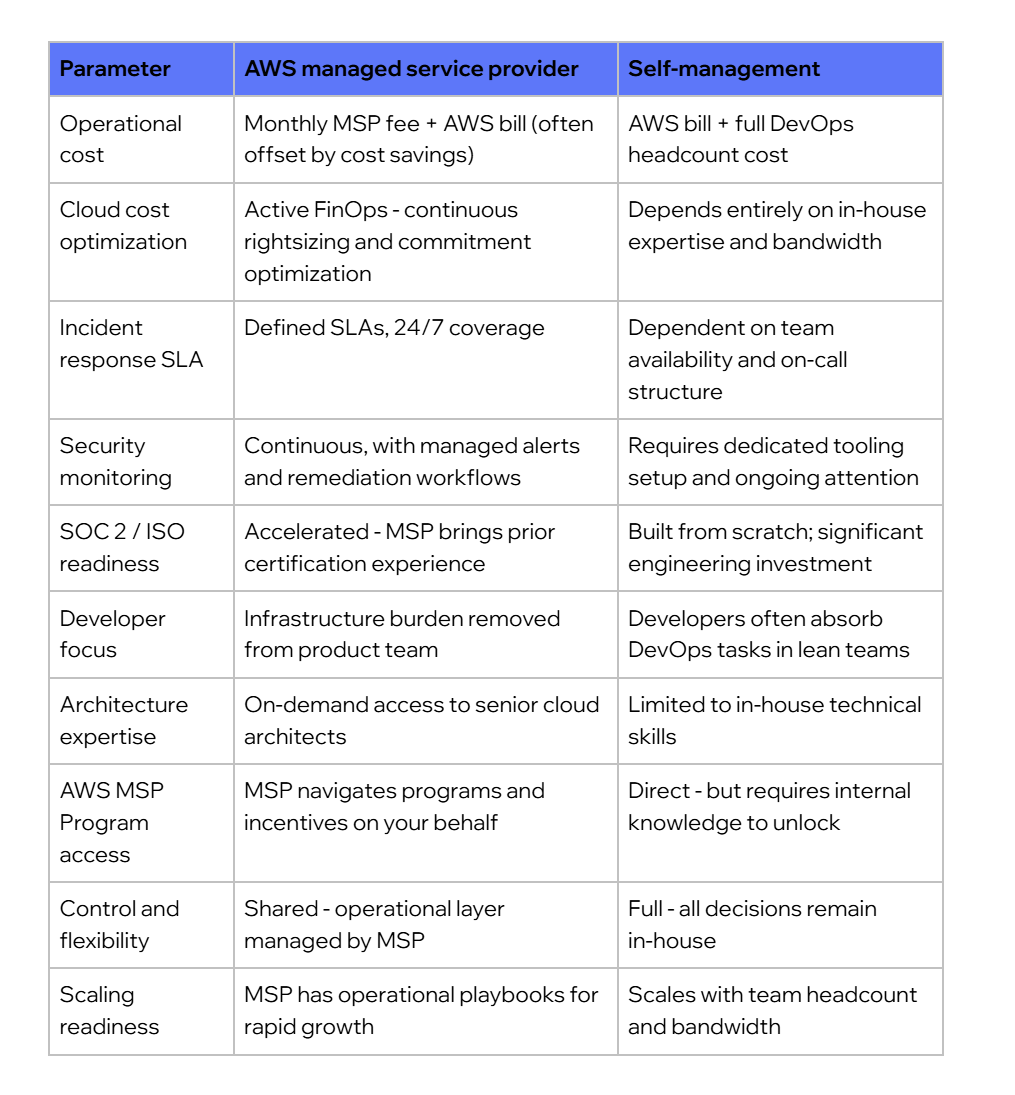
There is no single right answer - but there are clear signals. Watch for these signs: your AWS bill grows without a clear reason. Developers spend too much time on infrastructure rather than on the product. You have no dedicated owner for cloud cost optimization. You start enterprise sales that require SOC 2 or ISO 27001 certification. Hiring a senior DevOps engineer is hard and expensive. If several of these apply at once, the managed model is worth a serious evaluation.
Not all MSPs are equivalent. AWS tier classification is a starting point - Premier Partner status signals the highest level of verified expertise and commitment to the AWS MSP Program - but it should be the floor, not the ceiling of your evaluation.
AWS certification: Look for Premier Partner status in the AWS MSP Program. This requires demonstrated technical skills, a track record of customer success, and ongoing AWS investment.
Startup experience: Look for MSPs with experience in fast-growing companies. Scaling challenges differ from steady enterprise operations.
FinOps capability: Check for clear SLA commitments. They should use active FinOps methods with specific examples of savings delivered and methodologies used.
Compliance track record: They must have a good compliance record. Have they supported SOC 2 or ISO 27001 processes before? Can they provide references?
Cloud migration support: If you are still migrating workloads, ask specifically about cloud migration experience. AWS Partners with proven cloud migration playbooks that can reduce risk and accelerate timelines.
Commercial alignment: They should help you with AWS programs such as Startup credits and the Migration Acceleration Program (MAP) funding. A strong AWS managed service provider knows how to maximize the commercial relationship with Amazon Web Services.
Self-management works well for early-stage startups with strong technical skills and manageable cloud infrastructure complexity. The control is real, and when the team has the expertise and bandwidth, it is often the right choice.
As a startup scales, the calculus shifts. The cost of DevOps headcount, the drag of infrastructure work on product velocity, the complexity of FinOps, and the compliance requirements of enterprise sales all push in the same direction. A well-chosen AWS managed service provider doesn’t add a layer of bureaucracy - it removes one.
CloudZone helps growing international startups accelerate this shift - from self-managed infrastructure to a model where engineering teams focus on product. They move from self-managed cloud infrastructure to a model in which engineering teams focus on the product. Cloud operations scale reliably behind them. As an AWS Premier Partner operating within the AWS MSP Program, CloudZone brings senior cloud architects, active FinOps practices, and compliance experience to every AWS environment from day one.
An AWS managed service provider is a third-party company authorized by Amazon Web Services to manage cloud infrastructure on your behalf. MSPs manage ongoing operations. This includes monitoring, cost optimization, security, and architecture. They work under a defined service-level agreement. AWS recognizes MSPs through its Partner Network, with Premier Partner being the highest tier of verified expertise and commitment to the AWS MSP Program.
With in-house management, your engineering team handles all cloud operations. This includes provisioning, monitoring, cost control, and security. With an AWS managed service provider, an external team takes over the operational layer, freeing your developers to focus on the product. The key difference is not just who does the work, but the level of technical skills, expertise, and 24/7 coverage that an MSP brings, which is difficult to replicate with a small internal team.
Watch for these signs: your AWS bill grows without a clear reason. Developers spend too much time on infrastructure rather than on the product. You have no dedicated owner for cloud cost optimization. You start enterprise sales that require SOC 2 or ISO 27001 certification. Hiring a senior DevOps engineer is hard and expensive. If several of these apply, the managed model is worth a serious evaluation.
A strong AWS managed service provider applies active FinOps practices - not just monitoring costs, but continuously optimizing them. This work includes rightsizing underused instances, finding unused resources, and recommending the right mix of on-demand, Reserved Instance, and Savings Plan purchases. For startups without a dedicated FinOps function, an MSP effectively fills that role from day one.
Yes - and this is one of the most underestimated benefits of working with AWS Partners. An experienced AWS managed service provider already understands the control requirements, evidence collection, and audit processes that certifications such as SOC 2 Type II and ISO 27001 demand. They know which AWS environment configurations map to which controls, where auditors typically find gaps, and how to build the documentation trail efficiently. For startups entering enterprise sales, this can significantly compress the compliance timeline.


AI coding agents need better context. Selecting, compressing, and retrieving the right information can reduce waste across the entire agent workflow.

Picture a meeting room. Laptops open, screens flickering, everyone with that particular gleam in their eye. The first word in the air isn't "hello," it's "AI." And then comes the moment that always arrives: someone says, with total confidence, "We want ChatGPT. But ours. Now."


.png)