



How Context Optimization Makes AI Coding Agents More Efficient
AI coding agents need better context. Selecting, compressing, and retrieving the right information can reduce waste across the entire agent workflow.





In organizations of all sizes, from government ministries to global enterprises, the budget approval process is a critical yet often cumbersome function. Consider a research grant in which funds must be reallocated among predefined spending categories such as personnel, equipment, and travel. A surplus in one area could accelerate progress in another, but transferring it requires formal approval under strict, often complex financial rules. For decades, this process has been overwhelmingly manual. Each request, buried in a spreadsheet or email, demands meticulous review by financial officers who must cross-reference it against dense policy manuals.
This antiquated workflow is a recipe for delays, inconsistent decisions, and significant administrative overhead, diverting valuable expert time from strategic analysis to repetitive validation.
But a shift is underway. The rise of Generative AI offers a way to transform this bottleneck into a streamlined, intelligent, and transparent operation. This article explores how a sophisticated Artificial Intelligence technique, Retrieval-Augmented Generation (RAG), is shifting budget approvals from friction to a more efficient workflow. We will dissect the challenges of the manual process, define the goals for an automated system, and detail the technical solution that enables it, turning weeks of review into minutes of validated, explainable decisions.
The core challenge extends beyond mere automation. It involves creating a system that can navigate the demanding constraints of a real-world financial environment. Several interconnected problems plague the manual process.
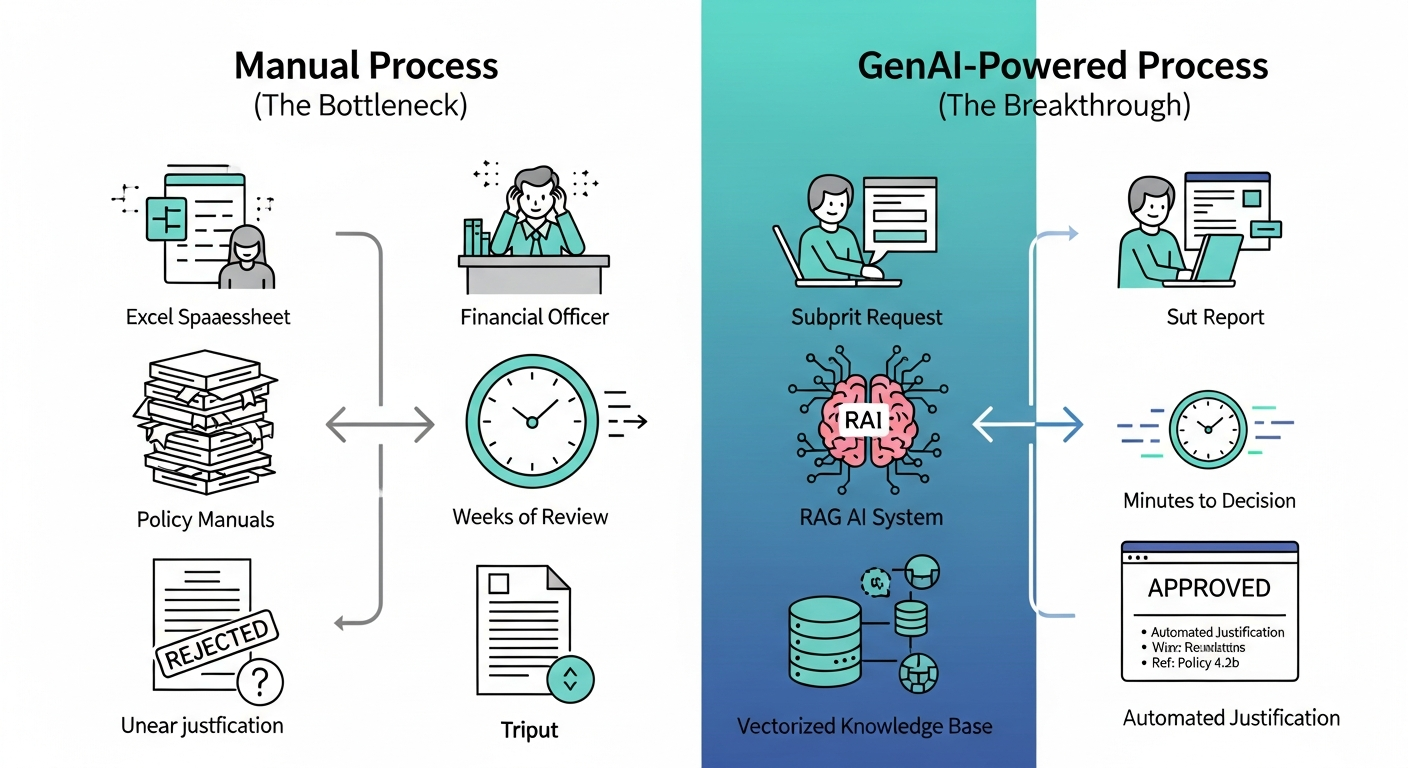
The manual budget approval workflow (left) creates bottlenecks, while the GenAI-powered RAG system (right) delivers rapid, transparent, and auditable decisions.
To overcome these challenges, we established a clear vision for success, defined by ambitious business and technical goals. The primary business objective was to fundamentally transform the operational model, shifting the finance team’s focus from administrative gatekeeping to strategic partnership.
Business Goals:
Technical Goals:
To meet these goals, we architected a serverless, event-driven solution powered by Generative AI, specifically using a Retrieval-Augmented Generation (RAG) framework. This approach grounds the power of Large Language Models in verifiable facts, creating a system that is not only intelligent but also trustworthy.
The architecture is straightforward. Budget requests uploaded as files to a cloud storage bucket trigger an automated pipeline. This pipeline’s core is an AI agent that uses RAG to connect a powerful LLM to a curated knowledge source containing all relevant financial policies and regulations.
Here is how the RAG process works to transform a simple user query, like a budget reallocation request, into an explained decision:
When a budget request is submitted, the RAG system’s retrieval component is activated.
The retrieved facts are then synthesized with the original request through sophisticated prompt engineering.
This output is derived from the external data provided by the retrieval step, making the process transparent and defensible.
{ "decision": "Rejected", "justification": "The transfer exceeds the limit defined in Section 4.2 of the 2023 policy manual. Reallocations above 10,000 NIS require audit committee approval, which is missing." }
The implementation of a GenAI-powered decision support system marks a fundamental shift from administrative friction to operational intelligence. This solution was never about replacing human expertise; it was about augmenting it. By empowering financial officers with a tool that handles the repetitive, time-consuming validation work, we free them to focus on strategic analysis, risk assessment, and complex financial planning.
Our system combines the speed of automation with the necessity of human oversight to deliver decisions that are fast, consistent, and fully explainable. Every recommendation is accompanied by a rationale directly tied to source documents. Every reviewer is armed with immediate context. And every decision is aligned with the latest compliance standards.
By leveraging a RAG-augmented knowledge base, the architecture is not only scalable and secure but also agile enough to evolve alongside changing regulations. In a world where trust is paramount, this approach ensures that AI in finance is not a black box but a transparent engine for better, faster, and more reliable decision-making. It transforms the budget approval process from a bottleneck into a faster, more reliable workflow, paving the way for a more efficient and intelligent future.
The system uses RAG to cross-reference every request against your specific policy manuals. This ensures that the AI’s logic is grounded in your organization’s actual rules rather than general information.
Yes. Every decision includes a detailed justification that cites the specific section and clause of the policy manual used to conclude.
Absolutely. The system is designed for adaptable intelligence. You can update its knowledge simply by adding new policy documents to its knowledge base without re-engineering the core system.
By automating the repetitive validation process, the system eliminates reviewer fatigue. It applies rules consistently across every request, ensuring uniform compliance.
It provides high scalability and reliability. The system can handle a sudden influx of requests while maintaining speed and accuracy, all while reducing infrastructure overhead.


AI coding agents need better context. Selecting, compressing, and retrieving the right information can reduce waste across the entire agent workflow.

Picture a meeting room. Laptops open, screens flickering, everyone with that particular gleam in their eye. The first word in the air isn't "hello," it's "AI." And then comes the moment that always arrives: someone says, with total confidence, "We want ChatGPT. But ours. Now."


.png)